
For warehouse managers, distribution center operators, and manufacturing engineers, motor selection is one of the highest-leverage decisions in conveyor system design. Get it right and the system runs reliably for years. Get it wrong and you're scheduling emergency maintenance during peak shipping season.
This guide covers the main types of DC motors used in conveyor applications, what differentiates them operationally, and a practical framework for matching motor specifications to real-world requirements.
Key Takeaways
- DC motors are preferred when variable speed control, compact footprint, or zone-based operation is required
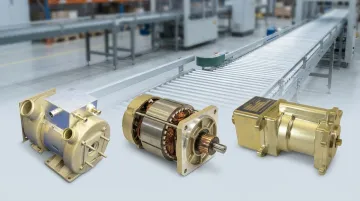
- Four motor types dominate conveyor applications: brushed DC (PMDC), brushless DC (BLDC), 24V motor-driven rollers (MDR), and wound DC
- Key selection factors: load weight, torque, speed variability, operating environment, duty cycle, and control system compatibility
- BLDC motors can exceed 25,000 hours of service life — roughly 5x that of brushed DC alternatives, according to FAULHABER
- Matching motor type to the specific application — not defaulting to habit — is the single most impactful selection decision
What Is a DC Motor for a Conveyor Belt?
A DC motor for a conveyor belt is an electric motor powered by direct current. It converts electrical energy into rotational mechanical force to drive the belt, rollers, or drive pulleys of a conveyor system.
What makes DC motors particularly useful in conveyor applications is their behavior under load: they deliver relatively consistent torque across varying load conditions, and their speed can be adjusted continuously through voltage or PWM signal changes without requiring a separate variable frequency drive (VFD) in many configurations.
That speed-control flexibility — combined with strong torque characteristics — explains why DC motors show up across several distinct conveyor configurations, each with different performance tradeoffs.
Types of DC Motors Used in Conveyor Systems
Brushed DC (PMDC) Motors
Permanent magnet DC motors use brushes and a commutator to deliver power to the rotor. They're cost-effective, easy to control via voltage regulation, and well-suited for light-to-medium duty conveyor lines.
The trade-off is maintenance: brushes require periodic inspection and replacement before they fall below the minimum serviceable length (Dorner/Bodine guidance specifies 0.125 in / 3.2 mm as the replacement threshold). Brush wear rate varies with duty cycle, load, speed, and ambient environment — there's no universal fixed interval.
Brushless DC (BLDC) Motors
BLDC motors eliminate brushes entirely, using electronic commutation for smoother, quieter, and more efficient operation. Oriental Motor documents speed regulation of ±0.2% in conveyor applications using feedback control — precision that brushed DC motors can't match.
BLDC motors are the better choice for:
- High-cycle-rate start-stop operation
- Variable-speed conveyor lines
- Applications where long service intervals matter, such as automated packaging and e-commerce fulfillment
24V DC Motor-Driven Rollers (MDR)
MDR systems embed a self-contained 24V or 48V DC brushless motor inside individual conveyor rollers. Each zone operates independently, enabling zero-pressure accumulation (ZPA) — product held in zones without items touching each other.
Interroll's EC5000 RollerDrive, for example, supports 24V and 48V DC, offers power levels from 20W to 50W, and integrates with ZoneControl and MultiControl logic via PROFINET, EtherNet/IP, and EtherCAT. That architecture makes MDR the dominant choice for sortation, accumulation, and distribution center applications.
Series and Shunt Wound DC Motors
Series wound motors deliver very high starting torque — useful for heavy-load conveyor startups where initial inertia is a concern. Shunt wound motors offer more stable speed regulation under varying loads.
ABB documents shunt wound DC motors from fractional HP up to 500 HP for larger industrial applications. You'll still find these in legacy systems and heavy industrial conveyor drives, though modern warehouse automation has largely shifted away from them.
Key Applications of DC Conveyor Motors Across Industries
DC motors appear across a wide range of conveyor applications, but the best-fit use cases cluster around three operational contexts.
Warehouses and Distribution Centers
24V MDR systems are the standard drive technology in modern distribution operations. Hytrol's zero-pressure accumulation conveyors use zone-based logic (EZLogic) to hold products in zones, prevent contact between items, and support sortation, merging, and diverting.
This combination of product protection and zone-level energy control makes MDR the natural choice for high-SKU-count operations where product damage and throughput consistency are both critical metrics.
Manufacturing and Assembly Lines
Brushed and brushless DC motors are common in manufacturing conveyor systems where components must move at controlled speeds between assembly, inspection, and packaging stations.
BLDC motors are the preferred choice where cleanroom conditions apply. Dynamic Conveyor documents that its cleanroom conveyors for pharmaceutical and medical applications use brushless DC motors specifically because they produce no motor emissions and meet Federal Standard 209D Class 1 / ISO Class 3 requirements.
E-Commerce Fulfillment and Packaging Operations
The variable-volume, high-cycle nature of fulfillment operations puts heavy stress on motors. BLDC-driven conveyors and MDR systems handle frequent start-stop cycling without the brush wear that degrades PMDC motors under similar conditions. The modular zone architecture of MDR also supports phased capacity expansion — a practical advantage for fulfillment operations that scale seasonally.
How to Choose the Right DC Motor for Your Conveyor Belt
Mismatched motor specifications are the leading cause of premature motor failure and unplanned downtime. Getting selection right the first time means working through these five factors before committing to any unit.
Load Capacity and Torque Requirements
The motor must produce enough torque to move the maximum expected load without exceeding its rated current draw.
CEMA's standard formula for belt conveyor drive horsepower is:
hp = (Te × V) / 33,000
where Te is effective tension in pounds and V is belt speed in feet per minute. Oriental Motor defines load torque as force multiplied by pulley radius (T = F × r), with required torque calculated as the sum of load torque and acceleration torque, multiplied by a safety factor.
Undersizing torque capacity is the most common selection error. For conveyor systems handling variable loads — mixed SKU distribution lines, for instance — a torque safety margin above calculated peak load is standard practice to prevent stall conditions during surge periods.
Speed Control and Variability
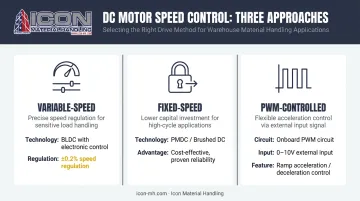
- Variable-speed applications: BLDC with electronic speed control. Oriental Motor's BLDC conveyor drives achieve ±0.2% speed regulation, which matters for product spacing accuracy and labeling precision.
- Fixed-speed applications: A PMDC or brushed DC motor is often sufficient and more cost-effective, reducing upfront capital investment without sacrificing reliability.
- PWM-controlled applications: Dorner's impac 100 DC controller uses a PWM circuit board with minimum/maximum speed settings, acceleration/deceleration ramp control, and an optional 0–10V external speed input — all without requiring a VFD.
Operating Environment and Ingress Protection
The physical environment determines the required motor enclosure rating. IEC 60529 defines IP protection levels:
| IP Rating | Protection Level | Typical Application |
|---|---|---|
| IP54 | Dust and splash protection | General warehouse, light manufacturing |
| IP65 | Dust-tight, water-jet protection | Food processing, washdown areas |
| IP66 | Dust-tight, high-pressure water | Heavy washdown, outdoor logistics |
| IP67 | Dust-tight, immersion to 1 meter | Pharmaceutical, wet environments |
Ambient temperature is equally important. WEG documents Class F insulation at a 155°C maximum and Class H at 180°C. In high-temperature environments, specifying the correct insulation class prevents winding degradation under sustained thermal load.
Duty Cycle and Start-Stop Frequency
Conveyor systems in batch processing or ZPA accumulation environments may cycle on and off hundreds of times per shift. IEC 60034-1 S3 defines intermittent periodic duty as sequential identical run/rest cycles at constant load, where the motor doesn't fully cool between cycles.
- Brushed DC motors are rated for lower cycle frequencies due to brush and commutator wear under high-frequency switching
- BLDC and MDR motors are designed for high-frequency start-stop operation and are better suited to S3 cyclic duty profiles
- Interroll's EC5000 tracks operating hours and start cycles via CANopen, supporting preventive maintenance scheduling based on usage data
Power Supply and Control System Integration
Voltage compatibility must be confirmed before specifying a motor:
- 24V / 48V DC: Standard for MDR systems (Interroll EC5000, Hytrol E24)
- 0–90V DC / 130V DC: Dorner's DC controller range for light-to-medium industrial conveyors
- Higher voltage DC (180V+): Heavier industrial conveyor drives
Control integration matters as much as voltage. Interroll's MultiControl supports PROFINET, EtherNet/IP, and EtherCAT, and can operate autonomously or through PLC fieldbus communication. Verify compatibility with your existing PLC and control architecture before finalizing any motor spec.
Total Cost of Ownership
Purchase price is one line item in a 5–10 year cost picture. The variables that shift the math:
- Brush replacement frequency for PMDC motors (variable by duty cycle and environment)
- MTBF differences: FAULHABER documents BLDC motor service life exceeding 25,000 hours — approximately 5x that of comparable brushed DC motors
- Idle energy consumption: Itoh Denki states its 24V DC motorized roller systems can deliver up to 60% energy savings versus traditional conveyor systems by running only when product is present; Interroll's 2015 EC310 data cites up to 30% energy savings for MDR configurations
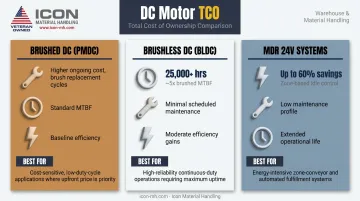
BLDC and MDR motors cost more upfront. For operations running multiple shifts or high start-stop cycles, that premium is usually recovered within the first major maintenance interval — often well before year three.
How Icon Material Handling Can Help
Icon Material Handling is a USA-based provider of custom material handling and warehouse automation solutions, serving warehouses, distribution centers, manufacturing facilities, and 3PL operations — with a primary focus on Michigan and its bordering states, including Indiana, Ohio, Wisconsin, and Illinois.
For conveyor systems specifically, Icon Material Handling offers:
- Roller, belt, gravity, and powered conveyor systems engineered around specific throughput targets, facility layouts, and operational constraints — built new or sourced used to fit the project
- New and used equipment available across all conveyor types, giving operations budget flexibility without sacrificing performance
- Fully insured professional installation scheduled around your facility's operating hours — including off-shift and phased install options — to keep production running
- AGV-compatible conveyor configurations for facilities moving toward integrated automation
Icon Material Handling's team works through the full project scope — from motor-driven conveyor selection for new distribution center builds to retrofitting existing lines for better zone control and throughput. The starting point is your operational profile: volume, layout, load types, and automation goals.
To discuss your conveyor system requirements, contact Icon Material Handling at Sales@icon-mh.com or +1 248-971-1455.
Conclusion
Selecting the right DC motor for a conveyor belt comes down to matching the motor to your specific application — not defaulting to the most powerful option or the most commonly specified one. Load requirements, speed profile, operating environment, duty cycle, and control system compatibility all factor into that decision.
A motor that performs well in a fixed-speed light manufacturing line will likely underperform in a high-cycle fulfillment operation. Keep these variables in focus as you evaluate options:
- Load and torque requirements — sized for peak demand, not average load
- Speed range and control needs — whether fixed-speed or variable-speed operation is required
- Duty cycle and thermal tolerance — especially in high-throughput or continuous-run environments
Revisit motor selection as your operation changes. A unit sized for today's throughput can become a bottleneck when facility volume grows or line configurations shift.
Frequently Asked Questions
How do you choose a motor for a conveyor belt?
Start with load weight, required belt speed, and pulley radius to calculate torque requirements using T = F × r and the CEMA horsepower formula. Then factor in operating environment (IP rating), duty cycle frequency, and whether variable speed control is needed. These variables together determine whether brushed DC, BLDC, or MDR is the right fit.
What are the four types of DC motors?
The four main types are series wound, shunt wound, permanent magnet DC (PMDC/brushed), and brushless DC (BLDC). In modern conveyor applications, BLDC and 24V MDR configurations are most common; series and shunt wound motors appear primarily in legacy or heavy industrial systems.
What is a VFD on a conveyor?
A Variable Frequency Drive (VFD) is a controller used with AC motors to vary speed by adjusting input frequency and voltage. DC motors achieve comparable speed variability through voltage adjustment or PWM control — typically without a separate VFD, using onboard PWM settings or a 0–10V external speed signal instead.
What is a 12V DC motor used for in conveyor applications?
12V DC motors are suited to light-duty, small-scale applications such as laboratory conveyors, prototype systems, or small packaging lines. Most industrial warehouse and manufacturing conveyors require 24V, 48V, or higher voltage motors to deliver adequate torque and reliability under sustained load.
Are DC motors better than AC motors for conveyor belts?
DC motors are generally better when variable speed, precise control, or zone-based operation is required. AC motors are preferred for fixed-speed, continuous-duty, high-load applications where simplicity and lower motor cost matter more.
How much horsepower does a conveyor belt motor need?
CEMA's standard formula is hp = (Te × V) / 33,000, where Te is effective tension and V is belt speed. Most light-to-medium warehouse conveyors operate in the 0.25–1 HP range; heavy industrial conveyor drives can reach 5–50 HP or more depending on load and belt length.