
Roller conveyor blasting systems solve this by moving steel plates, I-beams, structural profiles, and pipes through a sealed blast chamber in one continuous, uninterrupted pass. The machine never stops. Parts load at one end and exit blast-clean at the other, ready for coating, welding, or downstream assembly.
This guide covers the top roller conveyor blast systems available to US manufacturers, the technical specs that actually matter when comparing them, and what to watch out for before signing a purchase order.
Key Takeaways
- Roller conveyor shot blasting systems deliver continuous, in-line surface preparation—no batch loading, no cycle-time gaps
- Turbines positioned above and below the roller bed achieve full surface coverage on flat parts in a single pass
- Compare these specs: entrance envelope, conveyor speed at target Sa grade, turbine count and kW, liner material, and media reclaim design
- Leading US-market systems come from Rösler, Gibson/Empire, Wheelabrator, Pangborn, and Goff
- Request a test blast on your actual parts before committing—catalog specs won't reveal how a machine handles your specific geometry and finish requirements
What Are Roller Conveyor Systems for Continuous Blasting Lines?
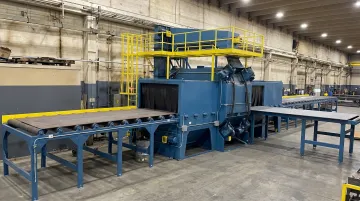
Roller conveyor shot blasting machines are industrial systems where powered steel rollers transport workpieces (flat plates, structural profiles, beams, pipes) horizontally through a sealed blast chamber. Inside, high-speed turbines or pressure nozzles propel abrasive media at the metal surface to clean, descale, or profile it for downstream coating or welding.
The defining advantage over cabin (batch) blasting is continuity. In a batch system, you load parts, seal the chamber, blast, then stop everything to unload before the next cycle begins. Every load/unload sequence is dead time. Roller conveyor systems eliminate that entirely: parts enter one end and exit the other without ever pausing the machine. That uninterrupted throughput is what makes them the right fit for high-volume production lines.
Where These Systems Fit in a Production Workflow
Roller conveyor blasters are typically positioned in-line, directly after flame cutting, plasma cutting, or plate forming. Blasted parts move immediately downstream to primer application, welding stations, or assembly—no intermediate storage step required. As The Fabricator notes, advanced automated lines integrate blasting, cutting, painting, and loading into a single workflow.
Planning note: In-line placement has real space and foundation implications. These machines require:
- Plan for floor depth to accommodate below-grade screw conveyors and abrasive return systems
- Confirm overhead clearance for roof-mounted dust collectors before finalizing layout
- Coordinate electrical systems with upstream and downstream conveyors for synchronized part flow
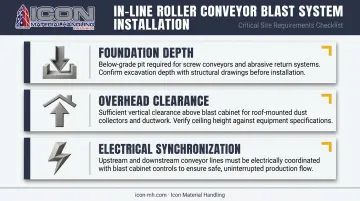
Get your civil and electrical engineers involved before finalizing machine selection.
Best Roller Conveyor Systems for Continuous Blasting Lines
The following systems were selected based on demonstrated performance in continuous blasting applications, chamber construction quality, turbine or nozzle technology, part size flexibility, and availability of US-based service and support.
Rösler Oberflächentechnik — RRB Series
Rösler is a Germany-headquartered surface treatment manufacturer with a strong US presence. Their RRB (Roller Conveyor Blasting) series is built for continuous processing of steel plates, flame-cut parts, structural profiles, and pipes in maritime, heavy equipment, and fabrication environments.
The RRB series stands out on several fronts. Their Gamma Y-blade turbines deliver 20% higher blast performance and up to 15% energy savings versus conventional blade designs, with blade replacement done through the turbine housing top lid (no full disassembly required). The blast chamber uses 8 mm manganese steel with overlapping, exchangeable wear plates. The dust collector mounts on the machine roof, preserving floor space in tight production layouts.
| Specification | RRB Series Details |
|---|---|
| Part size range | 1,000 mm W × 500 mm H (RRB 11/5) up to 4,500 mm W × 600 mm H (RRB 47/6-HD); custom systems up to 5,000 mm wide |
| Conveyor speed | 1.5–4.0 m/min (blast performance); up to 6 m/min pass-through |
| Turbine count & power | 4–8 Gamma turbines (standard RRB); 6–16 on RRBK weldment models; 7.5–37 kW per turbine |
| Chamber construction | 8 mm manganese steel; exchangeable wear plates; hardened tool-steel rollers |
| Documented surface profile | Rz = 70 µm achieved in a maritime propulsion application using round steel shot |
| Roller pitch | 400 mm (documented in RRB 22/5 case) |
Gibson Abrasive Equipment — Wheel Blast Roller Conveyor Systems
Gibson Abrasive Equipment, a subsidiary of Empire Abrasive Equipment (Langhorne, PA), builds wheel blast solutions for industrial surface finishing. Their roller conveyor systems handle flat plate, structural steel, and fabricated components in continuous production environments across the US.
Gibson's systems support custom-engineered configurations with variable-speed roller conveyors and PLC controls, mechanical abrasive reclaim with air-wash separators, and turbine placement optimized for full coverage of wide, long flat plates. The systems are designed for 24-hour automated production with integration into downstream paint lines. Fork-truck loading support is available, which matters in facilities where parts arrive from remote cutting stations.
Empire's companion In-Line XL system (pressure nozzle variant) handles flat plates up to 60 inches wide × 156 inches long using 8 pressure nozzles and a variable-speed powered roller conveyor—useful context for facilities evaluating both wheel blast and air blast options from a single vendor group.
| Specification | Gibson Details |
|---|---|
| Roller conveyor width | 24–96 inches standard; custom widths available |
| Blast wheels | Typically 4–12 blast wheels |
| Media reclaim | Air-wash separator; mechanical reclaim system |
| Controls | PLC with variable-speed drive |
| Integration options | Fork-truck loading, paint line integration, 24-hour automated operation |
Wheelabrator Group — Roller Table Blast Machines (Type G)
Wheelabrator is one of the largest wheel blast equipment manufacturers globally, with manufacturing and service support across North America. Their Type G roller table blast machines are widely deployed in structural steel mills, pipe processing facilities, and plate processing centers.
The Type G is engineered for continuous through-feed cleaning of metal plates and profiles. Wheelabrator explicitly documents work speeds of 0.8–3.0 m/min to achieve B Sa 2.5 under ISO 8501—one of the few manufacturers to publish a speed-to-finish-grade relationship directly. The cabinet uses hardened manganese steel at 35 HRC to over 50 HRC hardness. Post-blast rotating brushes and high-pressure blow-off return abrasive to circulation via screw conveyor, maintaining consistent media quality.
| Specification | Type G Details |
|---|---|
| Entrance width | 700 mm (RB 600G) to 3,300 mm (RB 3000G) |
| Standard entrance height | 550 mm |
| Roller pitch | 650–800 mm standard |
| Conveyor speed | 0.8–3.0 m/min at B Sa 2.5 |
| Blast wheels | 4, 6, or 8 wheels; 5.5–18.5 kW per wheel |
| Chamber hardness | 35 HRC to over 50 HRC manganese steel |
| Reclaim system | Screw conveyors, bucket elevator, air-wash separator |
| Industries served | Steel construction, shipbuilding, steel trade |
Pangborn Corporation — Continuous Roller Conveyor Blast Systems
Pangborn Corporation (Fairburn, GA) is a US-based blast equipment manufacturer with over a century of history in industrial surface preparation. They build roller conveyor blast systems for plate, pipe, and structural section processing, offering both standard and custom-engineered solutions.
Pangborn's domestic manufacturing base translates to faster lead times and parts availability for US customers compared to import-dependent suppliers. Their systems use Genesis Wheel technology with a high-efficiency separator and P-41 alloy chamber construction.
Pangborn supports custom engineering for non-standard part dimensions, automation integration, and offers direct US field service.
| Specification | Pangborn Details |
|---|---|
| Product focus | Heavy plates, structural shapes, continuous-flow processing |
| Turbine technology | Genesis Wheel with high-efficiency separator |
| US manufacturing | Fairburn, GA (30213) |
| Custom capabilities | Non-standard part dimensions, special media compatibility, automation integration |
| Service | Direct US parts availability and field service |
Goff Inc. — Heavy-Duty Structural Blast Equipment
Goff Inc. (Seminole, OK) manufactures heavy-duty blast equipment with a track record in oil and gas, construction equipment, and heavy fabrication. Their Structural Blast machines (including the SB 4 model) are engineered for durability in extreme-duty, high-abrasion production environments.
Fabricators frequently specify Goff for very heavy structural components: large beams, thick-wall pipe, and heavy castings where lighter-duty systems wear prematurely. US-based fabrication supports high customization in chamber sizing, turbine layout, and conveyor speed. For facilities running abrasive-intensive production around the clock, Goff's rugged construction typically reduces total wear-part replacement costs across the system lifecycle.
| Specification | Goff Details |
|---|---|
| Product line | Structural Blast machines (SB series) |
| Primary markets | Oil and gas pipe, heavy fabrication, structural steel |
| Manufacturing | Seminole, OK |
| Customization | Chamber sizing, turbine layout, conveyor speed—configured to application |
| Procurement note | Request model-specific datasheets; published specs are limited online |
Key Features to Look for in a Roller Conveyor Blasting System
Roller Pitch and Part Size Compatibility
Roller pitch—the center-to-center spacing between rollers—determines the minimum part length a system can handle without a transport frame. This varies more than most buyers expect: Rösler documents 400 mm pitch on the RRB 22/5, while Wheelabrator Type G runs 650–800 mm as standard. A part shorter than the pitch will fall between rollers unless carried on a sled or frame, adding handling time and defeating the purpose of continuous operation.
Check your smallest production part against the system's pitch before anything else. Also verify maximum part width, height, and weight—entrance envelope constraints eliminate a lot of systems before you get to performance specs.
Turbine Count, Placement, and Blade Technology
Turbine placement above and below the roller bed ensures both faces of a flat plate get blasted in a single pass. Missing coverage on the underside means a second pass or manual touchup—neither is acceptable in a continuous line.
Blade design directly affects both speed and operating cost. Key factors to evaluate:
- Shot volume: Higher shot volume enables faster workpiece travel—one turbine at 500 lb/min versus multiple wheels at 1,500 lb/min translates to roughly 3× faster line speed at equivalent cleanliness
- Reversible blades: Y-blade and high-efficiency designs (like Rösler's Gamma turbines) flip when worn, extending usable life without replacement
- Energy efficiency: High-efficiency designs deliver more blast energy per kilowatt than conventional blades
Turbine drive power (kW) per unit directly determines whether you can hit your target surface profile. Sa 2.5 at 2 m/min is a different machine configuration than Sa 2.5 at 0.8 m/min. Get the relationship between turbine kW, conveyor speed, and target Sa grade in writing from any vendor you're seriously evaluating.
Chamber Construction and Wear Resistance
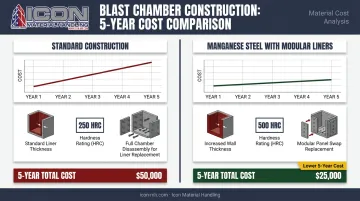
The blast environment destroys mild steel quickly. Chambers built from thick manganese steel with overlapping, replaceable liner plates outlast standard construction by a significant margin. Wheelabrator documents hardness of 35 HRC to over 50 HRC; Rösler uses 8 mm manganese steel with exchangeable wear plates.
Ask every vendor for:
- Chamber wall thickness and liner material hardness
- Expected liner replacement intervals at your projected throughput
- Whether replacement is modular (individual plates) or requires major disassembly
Run those numbers against purchase price—liner replacement costs routinely flip which system is actually cheapest over a 5-year horizon.
Abrasive Media Recovery and Recycling
Poor reclaim design is one of the most common hidden cost drivers in continuous blast systems. When fines and contamination aren't properly separated, media quality degrades and blast intensity drops.
The result is inconsistent surface finish—often invisible until a coating fails inspection.
A well-designed reclaim system includes:
- Bucket elevator to return spent media to the classifier
- Air-wash separator to remove fines, dust, and contaminants
- Automatic return of cleaned, sized media to the turbine hoppers
Wheelabrator documents screw conveyors, bucket elevator, and air-wash separator with post-blast brush and blow-off. Rösler documents cascade air-wash separation and automatic abrasive return. Gibson lists air-wash separator as standard. Any system without documented separator specifications deserves a harder look.
Integration Readiness and Control System
A roller conveyor blaster that can't sync with surrounding equipment becomes a bottleneck, not a solution. Look for:
- Variable-speed roller drive with upstream/downstream synchronization
- PLC with program storage for multiple part profiles
- Alarm and fault indication that integrates with plant-wide monitoring
- E-stop interlocks compatible with adjacent equipment
PLC controls with a touch panel let operators save and recall blasting programs for different part types—eliminating manual readjustment between runs.
How We Chose the Best Roller Conveyor Blasting Systems
Systems were assessed on proven continuous blasting performance (not just catalog specs), part size flexibility, chamber construction quality, turbine technology, US market presence, and aftermarket service support.
Two buyer mistakes come up repeatedly:
- Underspecifying roller pitch and height clearance — leaving facilities unable to process their full product mix without transport frames
- Skipping the test blast — choosing systems based on brochure performance without verifying the turbine configuration achieves the required Sa grade and Rz profile on actual production parts
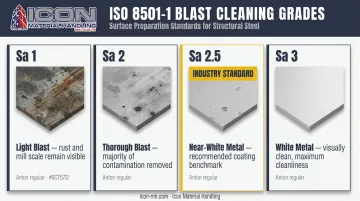
ISO 8501-1 Sa 2.5 (equivalent to SSPC-SP 10/NACE No. 2 Near-White Metal) is the benchmark for most industrial and maritime coating systems. Any vendor claiming Sa 2.5 capability should be able to provide documented test results at your target conveyor speed and part geometry—not just on ideal test coupons.
The conveyor system surrounding the blast chamber matters as much as the machine itself. Icon Material Handling supplies powered roller conveyors and AGV-compatible conveyor integration systems that handle upstream part infeed from cutting lines and downstream transfer to primer or coating stations.
Icon serves manufacturers across Michigan, Indiana, Ohio, Wisconsin, and Illinois.
Conclusion
The right roller conveyor blast system is the one that fits your specific production envelope, achieves your required surface finish at your required throughput, and keeps doing that without excessive downtime or media waste for years.
Brand reputation is a starting point, not a conclusion. Before finalizing any purchase:
- Request a test blast on your actual production parts
- Get documented lifecycle cost data: liner replacement intervals and media consumption rates
- Talk to references running similar part profiles and volumes
Once you've locked in the blast system itself, the surrounding material handling infrastructure becomes the next critical variable. Whether you're integrating into an existing line or building a new automated surface preparation workflow, Icon Material Handling's team can design the infeed conveyors, transfer equipment, and downstream powered roller systems configured for your parts and your facility layout.
Reach out at Sales@icon-mh.com or +1 248-971-1455 to discuss your project.
Frequently Asked Questions
What are the best roller conveyors for heavy-duty manufacturing lines?
For heavy-duty environments—structural steel, shipbuilding, heavy fabrication—the strongest options are systems built with thick manganese steel chambers, high-power turbines positioned above and below the conveyor bed, and mechanical media reclaim. Rösler, Wheelabrator, Pangborn, and Goff are the leading options for these applications in the US market.
What are the three types of conveyors used in blast line contexts?
The three most common types are roller conveyors (powered or gravity, best for flat plates and structural parts), belt conveyors (suited for smaller or irregular parts), and overhead/monorail conveyors (parts hang from a rail, used for complex 3D shapes like castings or welded assemblies). Roller conveyors dominate continuous blast line applications.
What is the difference between roller conveyor blasting and cabin blasting?
Cabin (batch) blasting requires loading parts into a sealed chamber, blasting, then stopping to unload before the next cycle—every load/unload sequence is dead time. Roller conveyor blasting is continuous: parts enter one end and exit the other without pausing the machine, delivering higher throughput and lower labor cost per part.
What roller pitch is recommended for continuous blasting lines?
Roller pitch varies by machine and application—Rösler documents 400 mm on the RRB 22/5, while Wheelabrator Type G runs 650–800 mm as standard. Parts shorter than the roller pitch require a transport frame to bridge the gap. Match the pitch to your smallest production part before selecting a system.
Can a roller conveyor blast system be integrated directly into an existing production line?
Yes—roller conveyor blast machines are designed for in-line placement, commonly after flame or plasma cutting. Integration requires upfront planning for foundation depth, overhead clearance for roof-mounted filters, and electrical synchronization with upstream and downstream conveyors.
What surface finish standards can roller conveyor shot blasting achieve?
Most systems reach Sa 2.5 (near-white metal) per ISO 8501-1, equivalent to SSPC-SP 10/NACE No. 2—Wheelabrator Type G and Rösler both document this in published specs. Exact results depend on turbine power, abrasive type, and conveyor speed.