Key Takeaways
- Bulk material handling covers moving, storing, and controlling loose dry materials (powders, granules, lumps) through a production facility
- Material properties (density, abrasiveness, flowability) determine equipment selection before anything else
- Core equipment includes belt conveyors, screw conveyors, bucket elevators, hoppers, and pneumatic systems
- Poor installation causes the most preventable system failures — misaligned pulleys, wrong belt tension, and bad hopper geometry are the usual culprits
- Icon Material Handling supplies new and used bulk handling equipment with custom fabrication and fully insured installation across Michigan and neighboring states
What Is Bulk Material Handling?
Bulk material handling is the engineering discipline focused on moving, storing, and controlling dry or semi-dry loose solids—powders, granules, pellets, flakes, lumps—through a production or processing facility from intake through to output. As ANSI/CEMA 550-2003 establishes, precise definition and accurate classification of bulk materials form the foundation of all conveyor engineering decisions, directly influencing the selection of horizontal, inclined, and vertical conveyor types and sizes.
This discipline is distinct from general material handling, which deals with unitized or packaged goods—pallets, cartons, containers—moved by forklifts, racking systems, and standard conveyors. Bulk materials cannot be individually packaged or counted. They flow, settle, bridge, and behave unpredictably based on their physical properties, which is why off-the-shelf equipment rarely works without modification.
Industries where bulk material handling is non-negotiable include:
- Mining and aggregates
- Food and grain processing
- Cement and construction materials
- Chemical manufacturing
- Plastics and rubber
- Pharmaceuticals
- Pulp, paper, and recycling
That breadth of industry demand adds up. According to Global Market Insights, the bulk material handling equipment market sits at $50.4 billion in 2025 and is projected to reach $81.4 billion by 2035 at a 5% CAGR—as more facilities automate high-volume material flows to keep pace with production demands.
Types of Bulk Materials and Their Handling Characteristics
Not all bulk materials behave the same way, and that variance drives every equipment decision downstream.
Key Material Categories
Common bulk materials span a wide range of physical behaviors:
- Minerals and ores — dense, abrasive, irregular particle shapes
- Grains, flour, sugar — fine to granular, moisture-sensitive, combustible dust risk
- Coal — moderate abrasiveness, dust hazard, variable lump size
- Sand, gravel, cement — highly abrasive, heavy, variable flowability
- Plastic pellets — smooth, free-flowing, low abrasiveness
- Chemicals — wide variability; some corrosive, hygroscopic (moisture-absorbing), or hazardous
- Wood chips — fibrous, interlocking, prone to bridging
Why Material Properties Drive Equipment Selection
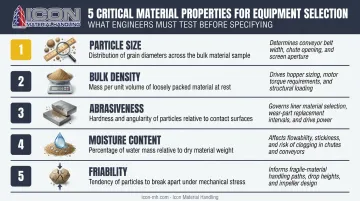
CEMA 550 classifies material characteristics into two groups: measurable physical properties and qualitative hazards affecting conveyability. The physical properties that engineering teams must test and document before specifying any equipment include:
- Particle size and lump size distribution — determines minimum bucket sizes, chute width, belt width, and screw diameter
- Bulk density — affects structural loads, conveyor capacity calculations, and drive power requirements
- Abrasiveness — defined by CEMA as the ability of a material to abrade particles from surfaces in moving contact, influenced by particle hardness, shape, density, and size
- Moisture content — affects flowability and may require sealed or temperature-controlled systems
- Friability — brittle materials require gentler conveying to avoid particle breakdown
Flowability and Hopper Design
Those physical properties don't stay abstract for long — they directly determine whether a hopper discharges cleanly or fails in the field. One parameter that trips up many system designers is angle of repose: the steepest angle at which a material pile remains stable without sliding.
Per AIChE's guidance on bin design, a 60-degree cone angle from horizontal is often insufficient to achieve mass flow for most bulk solids. Hoppers designed without proper flow testing regularly cause bridging, ratholing, and inconsistent discharge — all of which cascade into conveyor stoppages and throughput losses.
Getting material characterization right before equipment selection prevents these failure modes entirely.
Key Bulk Material Handling Equipment & Products
A bulk material handling system is only as effective as its individual components. Here's how the primary equipment categories function and when each is the right choice.
Hoppers and Chutes
Hoppers serve as the intake receptacles that store and meter bulk material into the system. Chutes direct material by gravity from one point to another. Both look straightforward on paper, yet both are frequent failure points when designed without accounting for the specific material.
Key design factors include hopper geometry (steep enough wall angles to prevent bridging), liner material selection (steel, rubber, or ceramic depending on abrasiveness and temperature), and discharge gate configuration that controls flow rate without clogging. AIChE identifies hopper angle, outlet size, wall friction, and flow properties as the four critical design variables that must be tested rather than assumed.
Conveying Equipment
The conveyor type should match the material, not the other way around:
| Conveyor Type | Best For | Key Consideration |
|---|---|---|
| Belt conveyor | High-volume, long-distance transport | Proper tension and alignment are critical |
| Screw conveyor | Powders and granules requiring containment | Hardsurfaced flights for abrasive materials |
| Pneumatic (dilute phase) | Fine, lightweight materials | High-velocity air transport |
| Pneumatic (dense phase) | Fragile or abrasive fine materials | Lower velocity reduces particle degradation |
| Bucket elevator | Vertical lifting of granular or lumpy materials | Particle size determines bucket and belt width |
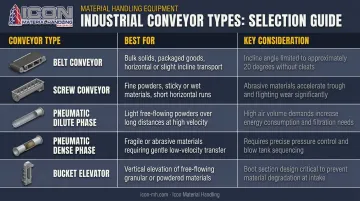
When fragile materials are involved, pneumatic conveying requires careful mode selection. As Jenike & Johanson notes, dense phase is generally preferred over dilute phase for fragile materials — though pneumatic conveying may still be unsuitable for some materials. This is another reason material testing must precede equipment selection.
Stackers, Reclaimers, and Storage Systems
Stackers accumulate bulk material in storage yards or silos; reclaimers retrieve it on demand. Modern systems often combine both functions into a single multipurpose unit. Primary bulk storage infrastructure includes:
- Silos — for granular or powder materials requiring weather protection
- Stockpiles — for large-volume outdoor storage of aggregates or coal
- Storage bins — for controlled indoor storage with discharge into feeders
Structural design for storage vessels follows ASME SBS methodology, which calculates loads based on container geometry and bulk-solids properties—not generic load tables.
Tension/Take-Up Units and Trippers
Take-up units maintain proper belt tension throughout a conveyor system's operating life. As belts stretch under load and temperature changes, the take-up unit adjusts to prevent sag. According to Pit & Quarry, inadequate belt tension causes belt sag and spillage—particularly in loading sections where material impact is highest.
Trippers are belt-conveyor accessories that divert material flow to create discharge points at multiple locations along a conveyor run. This enables flexible material distribution across a facility without installing multiple separate conveyor lines. Per CEMA's belt engineering standards, trippers and other accessories add to effective belt tension, meaning the drive and take-up system must be engineered to account for them.
Icon Material Handling stocks both new and used bulk material handling equipment, with custom fabrication available for components that require non-standard configurations. If your application doesn't fit off-the-shelf solutions, the team can engineer to your specific operational requirements.
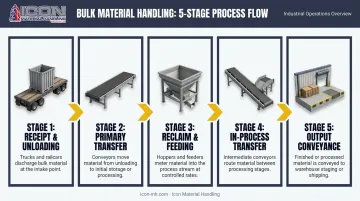
How the Bulk Material Handling Process Works
A well-designed bulk handling system follows a predictable sequence, regardless of the equipment or industry involved.
The End-to-End Flow
- Receipt and unloading — Material arrives by truck, railcar, or ship and is unloaded using dumpers, loaders, or ship unloaders
- Primary transfer — Conveyors or pneumatic systems move material to primary storage (silos, stockpiles, storage bins)
- Reclaim and feeding — Material is retrieved from storage via reclaimers, fed through hoppers and feeders into the processing or production line
- In-process transfer — Conveyors move material between production stations at engineered flow rates
- Output conveyance — Finished or processed material moves to packaging, shipping, or secondary storage
Automation's Growing Role
The automatic segment held approximately 42% of the bulk material handling equipment market in 2025, according to Global Market Insights, driven by the operational advantages of reduced manual intervention. Modern systems integrate:
- Flow rate and level sensors that monitor material in real time
- Automated feeders and discharge gates that regulate output
- Integrated monitoring platforms that track performance and flag anomalies across the full system
Automation directly supports safety compliance, too. OSHA requires belt-alignment monitoring devices on inside bucket elevators in covered grain facilities — a misaligned belt can trigger dust ignition.
Combustible Dust and Compliance Requirements
Combustible dust is one of the most serious hazards in bulk material handling. OSHA's combustible dust guidance cites CSB data identifying 281 combustible dust incidents between 1980 and 2005, resulting in 119 deaths and 718 injuries. For grain handling specifically, OSHA warns that just 1/8 inch of dust accumulation is enough to fuel a fire or explosion.
Other compliance and design requirements to account for:
- Silo and storage vessel load ratings calculated per ASME SBS standards
- Containment systems engineered for corrosive or hazardous materials
- Adherence to OSHA 1910.272 (grain handling) and NFPA 654 (combustible particulate solids)
Bulk Material Handling System Installation: What to Expect
Installation quality determines whether a well-specified system actually performs to design. Most long-term operational problems trace back to decisions made during installation, not equipment selection. Getting the pre-work right is where that process starts.
Pre-Installation Assessment
Before any equipment arrives on-site, a thorough facility assessment should cover:
- Material flow path mapping and space measurement
- Floor load capacity verification
- Headroom clearance for elevators, stackers, and overhead components
- Utility hookup points for electrical, pneumatic, and control systems
- Structural compatibility with the building for anchoring and vibration loads
CEMA 550 specifies that temperature, humidity, lump size distribution, and friability should all be documented before equipment selection is finalized—this same information should be confirmed on-site before installation begins.
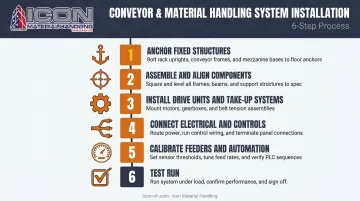
Typical Installation Sequence
- Anchor fixed structures — hoppers, conveyor frames, support structures secured to confirmed load-rated anchor points
- Assemble and align conveyor components — frames, idlers, and pulleys set to specification
- Install drive units and take-up systems — tensioned to engineering specifications, not by feel
- Connect electrical and control wiring — feeders, sensors, and automation controls wired and labeled
- Calibrate feeders and automation controls — discharge rates verified against design parameters
- Test run — conducted with actual or simulated material before full commissioning
Most Common Installation Mistakes
These errors account for the majority of early-life system failures:
- Improper belt tension — leads to sag, spillage, and excessive wear on idlers
- Misaligned pulleys — even minor misalignment causes edge wear, belt damage, and material spillage
- Inadequate hopper geometry — insufficient wall angles cause bridging, halting material flow
- Insufficient structural anchoring — particularly problematic in high-vibration environments
- Thermal expansion oversights — outdoor and high-temperature applications require expansion provisions that many installations omit
Avoiding these mistakes depends as much on installer experience as it does on engineering specs. Icon Material Handling's fully insured installation team handles projects across Michigan, Indiana, Ohio, Wisconsin, and Illinois, with scheduling designed to minimize facility downtime during commissioning.
Maintaining Your Bulk Material Handling System
OSHA 1910.272 requires preventive maintenance programs in covered grain-handling facilities—including prompt correction of overheated bearings and misaligned belts on bucket elevators. Skipping routine maintenance doesn't just risk equipment failure; it creates documented fire and explosion hazards.
Core Preventive Maintenance Tasks
- Belt inspection — check for wear, cracking, and misalignment on a regular schedule; ASGCO publishes a preventive maintenance schedule specifically for bulk material handling belt conveyors
- Bearing and chain lubrication — overheated bearings are a leading cause of belt slippage and dust ignition events
- Hopper liner inspection — abrasive materials wear liner surfaces; inspection intervals should match material abrasiveness data
- Belt tension and pulley alignment checks — belt tension changes over time; schedule verification, not just emergency response
- Control system calibration — sensors drift; feeder calibration should be validated periodically
Cleaning as Maintenance
Material buildup on conveyors, in hoppers, and around discharge points is one of the most overlooked maintenance failures in bulk handling operations. Accumulated material causes real operational damage:
- Increases motor load and accelerates wear on drive components
- Creates contamination risk in food- and pharmaceutical-grade systems
- Raises fire and dust explosion hazard in enclosed environments with combustible materials
In facilities handling combustible materials, cleaning frequency is a direct variable in explosion risk—not a housekeeping issue.
Component Replacement Strategy
Cleaning and inspection findings should feed directly into replacement planning. For high-wear components—belt liners, screw conveyor flights, bucket elevator cups—planned replacement is the difference between a scheduled hour of downtime and an unplanned multi-day stoppage. KWS notes that hardsurfaced screw conveyor flights are specifically used in abrasive applications to extend service life. A practical strategy:
- Track wear rates on friction-heavy components from the start of operation
- Stock critical spare parts for components with the highest failure consequence
- Schedule replacements based on wear data, not equipment failure
Frequently Asked Questions
What are the types of bulk material handling equipment?
Main categories include conveying systems (belt, screw, pneumatic, chain/drag conveyors, bucket elevators), storage and intake systems (hoppers, silos, stockpiles, storage bins), and distribution components (stackers, reclaimers, trippers, feeders). The right type depends on material properties and facility layout.
Is MHE a forklift?
MHE (Material Handling Equipment) is a broad category that includes forklifts, but also encompasses conveyors, racking systems, hoists, automated guided vehicles, and bulk handling equipment. Forklifts are one subset, used primarily for moving palletized or unitized loads, not loose bulk materials.
What is the bulk material handling process?
The end-to-end process starts at receipt (truck, rail, or ship) and moves material to primary storage via conveyors or pneumatic systems. From there, it's reclaimed and fed into production, then conveyed to shipping or secondary storage once processed.
What industries use bulk material handling systems?
Key industries include mining, food and grain processing, cement and aggregates, chemical manufacturing, plastics and rubber, pharmaceuticals, pulp and paper, and recycling. In short, any industry that processes or stores materials in loose or granular form rather than packaged units.
What is the difference between bulk material handling and general material handling?
General material handling deals with unitized or packaged goods using forklifts, standard conveyors, and racking systems. Bulk material handling addresses loose, dry, or semi-dry materials that cannot be individually packaged, requiring specialized equipment like hoppers, screw conveyors, and bucket elevators.
How do I choose the right bulk material handling equipment for my facility?
Start by characterizing the material: density, particle size, abrasiveness, moisture content, and flowability. Then define throughput requirements and map your facility layout to match those parameters to the right conveying, storage, and control system. For complex systems, partnering with an experienced supplier and installer prevents costly specification errors.