](https://file-host.link/website/icon-mh-qx2ir9/assets/blog-images/7818eb4e-ee19-4f71-8c0a-5c2dea94079c/1780036036698596_f1d0121967374719927e1e6a8dcccfac/360.webp)
Introduction
Picking the wrong material handling equipment supplier doesn't just cost money — it costs time, safety compliance, and operational momentum. A racking system that's poorly specified for your load types, or an automated conveyor installed by an underqualified team, can trigger costly redesigns, OSHA violations, and throughput bottlenecks that compound across months.
According to Grand View Research, the global material handling equipment market is estimated at $262.9 billion in 2025 and is projected to reach $421.79 billion by 2033. At that scale, supplier quality varies enormously — and a poor vendor decision locks your facility into equipment that stalls rather than supports growth.
This guide walks through six factors that separate a capable, long-term supplier from one that looks capable but underdelivers when it matters.
Key Takeaways
- Product range breadth and customization capability determine how precisely equipment fits your facility
- Total cost of ownership matters more than sticker price — factor in installation, maintenance, and expected lifespan
- Access to both new and used equipment gives you cost flexibility without sacrificing quality
- Insured installation and responsive support directly affect safety compliance and operational uptime
- The right supplier should scale with your business, not become a bottleneck to it
What Is a Material Handling Equipment Supplier?
MHI defines material handling as the movement, protection, storage, and control of materials and products throughout manufacturing, warehousing, distribution, consumption, and disposal. A supplier is the company that sources, configures, installs, and supports the equipment keeping those operations running inside your facility.
This is distinct from a manufacturer. Manufacturers produce equipment. Suppliers — and dealers who act as suppliers — match the right solution to each facility's specific constraints. That means accounting for floor load ratings, aisle widths, ceiling clearances, throughput patterns, and budget realities — before a single piece of equipment ships.
The Four Main Equipment Categories
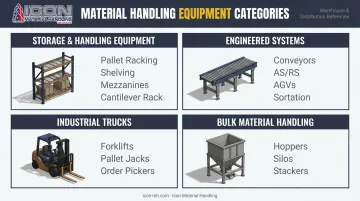
According to Thomasnet, material handling equipment falls into four broad groups:
- Storage and handling equipment — pallet racking, shelving, mezzanines, cantilever rack
- Engineered systems — conveyors, AS/RS, AGVs, sortation systems
- Industrial trucks — forklifts, pallet jacks, order pickers
- Bulk material handling equipment — hoppers, silos, stackers
When evaluating suppliers, look for meaningful coverage across at least the first two categories. The ability to integrate all four as your facility's needs grow is what separates a capable partner from a simple vendor.
6 Key Factors to Consider When Choosing a Material Handling Equipment Supplier
No two facilities have identical requirements. A pharmaceutical manufacturer's compliance demands differ sharply from a construction supply warehouse's throughput priorities. These six factors give operations teams a structured way to evaluate suppliers — on criteria tied directly to business outcomes, not just price or availability.
Factor 1: Breadth of Product Range and Customization Capability
A supplier with a narrow catalog forces compromise. You may get a product that's close to what you need — but not purpose-built for your load types, aisle configuration, or vertical constraints. That gap produces workarounds that slow throughput and complicate operations over time.
What to look for:
- Coverage across storage, conveyance, and engineered systems — not just one category
- Custom fabrication capability for non-standard configurations (unusual bay depths, odd-height uprights, bespoke automation integrations)
- Both stock and made-to-spec options, so procurement doesn't slow down implementation
Custom fabrication matters more than buyers often expect. Off-the-shelf racking may not accommodate irregularly shaped inventory or specialized load patterns. A supplier with an in-house fabrication team can engineer solutions that standard catalogs simply don't include.
Factor 2: Industry Experience and Technical Expertise
A supplier who has never worked in a pharmaceutical cleanroom or an aerospace-grade facility will underestimate the constraints involved. Sector-specific experience shortens implementation timelines and reduces the risk of costly redesigns.
Ask prospective suppliers:
- Have they worked in facilities with similar throughput volumes, regulatory requirements, or building constraints?
- Can their technical staff assess site-specific factors like floor load capacity, seismic requirements, or fire suppression clearances?
- Do they take a consultative approach, or do they lead with a product catalog?
Implementation timelines for complex systems are long. Modern Materials Handling reports that smaller AS/RS installations average around 18 months, with larger projects extending to three years or more. A supplier without deep project experience will absorb that time — and your budget — in avoidable errors.
KPIs this influences: Time-to-implementation, redesign frequency, long-term equipment reliability.
Factor 3: Total Cost of Ownership — Not Just Purchase Price
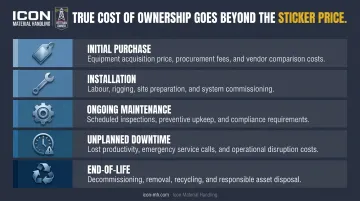
The purchase price is rarely the most important number. A complete TCO analysis should account for:
| Cost Component | What to Quantify |
|---|---|
| Initial purchase | Equipment price + shipping |
| Installation | Labor, downtime, third-party fees |
| Ongoing maintenance | Scheduled service, spare parts |
| Unplanned downtime | Lost throughput, idle labor, penalties |
| End-of-life | Removal, reconfiguration costs |
Access to both new and used equipment is a meaningful supplier attribute here. Used or refurbished racking and conveyor systems can deliver strong ROI for non-critical application areas or budget-constrained facilities. New equipment makes sense for high-demand, precision-sensitive operations where reliability is paramount. A supplier who only sells new — or only sources used — limits your procurement flexibility.
KPIs this influences: Capital expenditure per operational unit, maintenance costs, downtime hours per quarter.
Factor 4: After-Sales Support, Installation, and Ongoing Service
Professional installation directly affects equipment performance from day one. Improperly installed racking creates load distribution problems, structural risks, and OSHA violation risk. Confirm before signing:
- Does the supplier have a dedicated, trained installation team — or do they subcontract it?
- Is the installation team fully insured for on-site work?
- What is the scheduling model — and what's the typical lead time?
After installation, ongoing responsiveness matters. Ask specifically about service scheduling, technical assistance availability, and how quickly the supplier responds when equipment malfunctions mid-shift.
Downtime compounds fast. Siemens' 2024 research reports that unplanned downtime costs the world's 500 largest industrial companies $1.4 trillion annually — representing 11% of revenue. While warehouse-specific figures vary by facility, the cost drivers (idle labor, missed orders, emergency parts sourcing) apply directly to distribution and manufacturing environments.
KPIs this influences: Mean time to repair (MTTR), equipment uptime percentage, order fulfillment consistency.
Factor 5: Safety Standards and Insurance Coverage
Material handling equipment carries real injury risk. The BLS reports a 4.9 total recordable incident rate per 100 full-time workers in general warehousing and storage in 2024. OSHA's maximum penalty for a serious violation is $16,550, and willful or repeated violations can reach $165,514 per incident.
Before engaging any supplier's installation or service team for on-site work, verify:
- Full insurance coverage (general liability and workers' compensation at minimum)
- Adherence to OSHA 1910.176 standards for safe clearances and secure storage
- Documentation of design load ratings and installation compliance records
Insurance isn't a formality — it signals how seriously a supplier treats risk management. A supplier whose team works uninsured on your facility floor transfers liability directly to your organization.
KPIs this influences: Workplace incident rate, OSHA compliance score, liability exposure during on-site work.
Factor 6: Scalability and Long-Term Partnership Fit
Your facility's material handling requirements will change. SKU counts grow. New product lines require different storage configurations. E-commerce operations, per CBRE, typically require roughly three times more warehouse space than store-based retail models — a dramatic shift if your customer base trends that direction.
A supplier who can only serve your facility's current state will become a constraint as you grow. Evaluate:
- Can the supplier support facilities across multiple locations or states?
- Do they offer phased implementation options for budget-managed expansion?
- Can their solutions scale — both in equipment type and procurement volume?
Supplier consolidation matters here too. Managing fewer vendors reduces coordination overhead and often strengthens the service relationship, since the supplier has more context on your operations.
How Icon Material Handling Can Help
Each of the six factors above points to a specific capability gap that can stall a project or inflate costs. Icon Material Handling addresses all six as a B2B supplier of new and used warehouse and material handling equipment serving warehouses, distribution centers, 3PL and fulfillment operations, and manufacturing facilities across Michigan, Indiana, Ohio, Wisconsin, and Illinois.
Here's how Icon's capabilities map to the six factors above:
Product range: Pallet racking (tear-drop beams, uprights, wire decks), cantilever rack, mezzanines, specialty rack systems (push back, pallet flow, carton flow, drive-in), conveyance systems, AS/RS, safety guarding, pipe-and-joint (CREFORM), and in-plant offices — with both stock and custom-order options available.
Custom fabrication: Icon's in-house team builds to specification: non-standard upright heights, custom wire deck dimensions, specialty rack configurations, and AGV-compatible conveyance systems. If off-the-shelf products don't fit the application, fabrication does.
New and used inventory: Used equipment gives budget-constrained facilities access to quality solutions for non-critical applications; new equipment covers high-demand or precision-sensitive operations. Both options span multiple product lines.
Professional installation and removal: Icon's fully insured team handles complete setup, dismantling, and reconfiguration — scheduled around client timelines to minimize facility disruption.
Technical support and automation: Icon supplies custom-built automated solutions — AS/RS, robotic picking technology, and roller, belt, gravity, and powered conveyors — designed to improve throughput and reduce material flow bottlenecks.
For questions or project support, contact the Icon sales team at Sales@icon-mh.com or call 248-971-1455.
Conclusion
Choosing a material handling equipment supplier shapes daily operational performance — how efficiently your space is used, how reliably orders move, and how safely your team works. The right fit is a supplier whose product range, service model, and scalability match what your facility actually needs — not just what looks good on a spec sheet.
Supplier relationships aren't static. As your business grows, your evaluation criteria should sharpen alongside it. The partner who fits your facility today should be capable of growing with you — adding equipment types, supporting new locations, and adapting to throughput requirements that don't yet exist. Set that standard during the selection process, before you sign anything.
Frequently Asked Questions
What factors should you consider when selecting material handling equipment?
Key considerations include load type and weight, throughput requirements, facility constraints (aisle width, ceiling height, floor load capacity), applicable safety and regulatory standards, and total cost of ownership. A qualified supplier can assess these variables against available equipment options and help you avoid over- or under-specifying.
What are the four categories of material handling equipment?
The four standard categories are storage and handling equipment (racking, shelving, mezzanines), engineered systems (conveyors, AS/RS, sortation), industrial trucks (forklifts, pallet jacks, order pickers), and bulk material handling equipment. A full-service supplier should carry inventory and expertise across at least two or three of these categories.
What is the difference between a material handling equipment manufacturer and a supplier?
Manufacturers produce the equipment; suppliers source, configure, install, and support the right solution for each facility's specific needs. Suppliers typically offer broader solution flexibility, access to multiple brands, and stronger post-sale service than buying direct from a single manufacturer.
How do I evaluate a material handling supplier's after-sales support?
Ask about installation team credentials and insurance coverage, service scheduling and response time commitments, spare parts availability, and whether the supplier provides ongoing technical support. Document these terms before signing.
Should I consider used material handling equipment from a supplier?
Used or refurbished equipment can be cost-effective for non-critical applications or budget-constrained facilities. Look for suppliers who carry both new and used inventory and can speak specifically to the condition and suitability of used equipment for your application.
How often should I re-evaluate my material handling equipment supplier?
Supplier evaluation works best as an ongoing process, not a once-a-year checkbox. At minimum, conduct a structured review when significant operational changes occur — facility expansion, new product lines, throughput spikes, or major equipment investments.