
Introduction
Pole barn post decay quietly undermines post-in-ground buildings, agricultural structures, and industrial storage facilities. Many warehouse operators and facility managers overlook this risk until visible damage appears—often after significant structural compromise has already occurred.
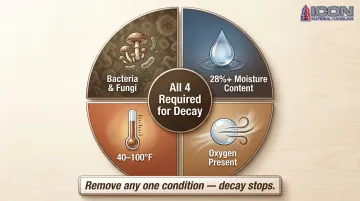
Do post protectors actually prevent decay? The answer depends on understanding what causes decay in the first place. According to USDA Forest Products Laboratory research, wood rot isn't caused by moisture alone—it requires oxygen, temperatures between 40–100°F, moisture content above 28%, and soil-dwelling microorganisms all working together.
Without all four conditions present, decay stalls. That's the insight that makes targeted protection strategies viable.
This guide covers the decay science, evaluates whether barrier sleeves genuinely hold up, and identifies the prevention strategies most likely to extend the life of your structural posts.
Key Takeaways
- Wood decay needs four conditions at once: oxygen, moisture above 28%, temperatures of 40–100°F, and soil microorganisms
- Post protectors work by creating a physical barrier that blocks moisture and microbes from reaching wood at the critical soil-to-post contact zone
- Pressure-treated lumber alone isn't permanent—chemical treatments leach and deplete over time, leaving posts vulnerable after 8-15 years
- Warning signs include soft wood at grade level, visible discoloration or crumbling, and structural leaning or misalignment
- Combining pressure-treated wood with barrier sleeves, proper drainage, and periodic inspection gives posts the longest service life
What Causes Post Decay in Pole Barns?
The common belief that "moisture causes rot" is incomplete. Moisture is necessary, but decay is actually caused by soil-dwelling fungi and bacteria consuming wood fiber as a food source. These organisms require four specific conditions to thrive simultaneously—remove any one, and decay cannot occur.
Soil-Dwelling Microorganisms
Bacteria, fungi, and insects living in soil are the actual agents of wood decay. They feed on wood fiber and are naturally abundant in in-ground environments. Direct soil-to-post contact gives these organisms unlimited access to the wood surface, especially problematic in pole barn applications where posts are buried several feet deep.
Primary decay agents include:
- Brown-rot fungi (Gloeophyllum trabeum, Rhodonia placenta) break down cellulose and hemicellulose, causing extreme shrinkage and cubical cracking
- White-rot fungi (Trametes versicolor) consume both lignin and cellulose, leaving bleached, spongy wood
- Soft-rot fungi (Chaetomium species) penetrate cell walls under high-moisture conditions
- Bacteria and actinomycetes colonize early and can degrade wood preservatives, opening the door to fungal decay
Moisture Saturation
Wood must reach approximately 28–30% moisture content before decay fungi can colonize. The USDA Forest Products Laboratory confirms that serious decay occurs only when moisture content exceeds the fiber saturation point (averaging 30%). Wood kept below 20% moisture content provides a reasonable safety margin against fungal damage.
In pole barn settings, soil contact and surface water runoff are the primary drivers of this saturation. Barn environments with wet hay or manure in stalls also introduce a moisture source that's frequently overlooked as a decay risk.
Temperature Range
Most decay fungi thrive between 40–100°F, with optimal growth at 77°F. In practice, most of the United States experiences these temperatures for the majority of the year, making temperature control an impractical prevention strategy. This is why eliminating other conditions—particularly moisture and microorganism access—becomes the practical focus of decay prevention.
Chemical Treatment Depletion
Pressure-treated lumber uses pesticide chemicals to poison wood fiber and deter microbial feeding. While effective initially, these treatments are subject to degradation and leaching once in ground contact.
USDA Forest Products Laboratory studies show that the most rapid leaching occurs within the first months of service, accelerated by high water flow, low pH, and water-soluble organic acids. Soil properties directly influence copper and arsenic depletion from treated wood.
Copper-tolerant brown-rot fungi have also evolved to neutralize copper-based preservatives by producing oxalic acid, which lowers ambient pH and forms non-toxic copper oxalate crystals. Treated posts can become vulnerable well before a pole barn's expected 30–50 year lifespan — which is precisely why passive chemical treatment alone is rarely enough.
Do Post Protectors Actually Work?
Yes, post protectors work—backed by decades of independent field research, not manufacturer claims alone.
Post protectors function as barrier sleeves that slide over the post before installation, positioning the top edge 4–6 inches above grade. This physical barrier separates wood from direct soil contact, interrupting two of the four decay conditions: moisture infiltration and microorganism access.
The Barrier Sleeve Mechanism
The protector creates a sealed envelope around the critical ground-line zone where 90% of post failures occur. By eliminating soil-to-wood contact, the sleeve:
- Blocks soil moisture from saturating the wood surface
- Prevents soil-dwelling fungi and bacteria from reaching the wood
- Keeps the wood's moisture content below the 28% threshold required for decay
- Allows the post to remain in the "safe zone" below 20% moisture content
Material Longevity
Premium post protectors are manufactured from high-density polyethylene (HDPE) geomembrane material, the same polymer used in landfill liner construction. According to Geosynthetic Institute (GRI) testing under ASTM D3895 standards, 1.5mm HDPE geomembranes have a predicted half-life of 449 years at 68°F in buried conditions.
Thinner molded sleeves carry different lifespan ratings, but even these far outlast the service life of the building they support.
Independent Field Test Results
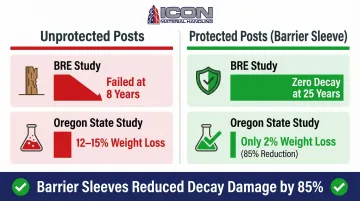
A Building Research Establishment (BRE) 25-year study used EN252 European standards to compare preservative dip-treated stakes with and without barrier sleeves. The difference was stark:
- Unsleeved treated stakes began decaying after 3 years and failed completely after 8 years
- Stakes fitted with barrier sleeves showed zero decay at the ground line after 25 years
An Oregon State University study (2009) tested 2-mil polyethylene boots on untreated Ponderosa pine stakes in a fungus cellar:
- Unprotected posts suffered 12-15% weight loss due to decay (causing extreme strength loss)
- Protected posts experienced only 2% weight loss, an 85% reduction in decay damage
Leaching Prevention Benefit
The barrier sleeve doesn't just block external moisture. It also prevents chemical preservatives from leaching out of the wood into surrounding soil. This keeps treatment concentration where it's most needed and significantly extends the effectiveness of pressure-treated lumber.
Drainage and Venting Features
Quality barrier sleeve designs address concerns about trapped moisture through vertical venting channels and optional base drainage holes. These features allow water to exit the sleeve while still denying soil contact, preventing condensation buildup inside the barrier.
What Happens When You Ignore Post Decay
Unchecked decay weakens posts from the ground up, reducing load-bearing capacity and creating serious safety risks. Brown-rot fungi can cause severe strength reductions in early decay stages, well before any visible weight loss appears.
As the structural cross-section diminishes at the critical ground-line zone, consequences escalate:
- Partial structural sagging and connection overstress
- Building settlement and misalignment
- Door and panel operation failures
- Complete structural collapse in severe cases
In commercial or industrial pole barn storage facilities, a compromised structure means unexpected downtime, inventory exposure, and emergency repairs. For warehouses storing valuable equipment or materials, the impact spreads quickly—halting personnel access, putting inventory at risk, and forcing costly unplanned repairs.
Warning Signs Your Posts Are Already Failing
Early detection is critical. Inspect posts annually for these indicators:
- Soft or spongy wood at or just below grade level when probed with a screwdriver or awl
- Visible darkening, crumbling, or fibrous breakdown of wood at the soil line
- Posts beginning to lean or shift under load
- Doors or structural panels that no longer align or close properly
- Cracks or checks that expose untreated heartwood to moisture
The Cost Differential
Post protector barrier sleeves cost less than $3.00 per post at installation. Replacing a single failed structural post requires excavation, temporary structural shoring, cutting the compromised post, installing engineered concrete piers or steel brackets, and facility downtime—costs that can exceed $1,500-$3,000 per post, not including operational disruption.
A $3.00 sleeve at installation versus $3,000 in emergency remediation makes the math straightforward.
How to Prevent Post Decay: A Layered Protection Strategy
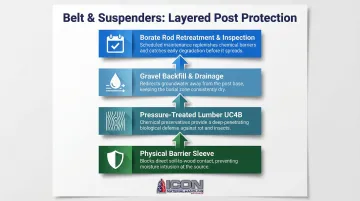
Maximum post longevity comes from a "belt and suspenders" approach — stacking physical barriers, smart installation practices, and the right material selection so each layer compensates for the weaknesses of the others.
Physical Barrier Sleeves
Slide a post protector barrier sleeve over the post before setting it in the ground, with the top edge extending 4–6 inches above finished grade. This eliminates soil-to-wood contact entirely, blocking both moisture migration and microorganism access at the moment of installation — making it the single most effective intervention in the layered system.
Pressure-Treated Lumber Selection
Even with a barrier sleeve in place, select pressure-treated lumber rated for ground contact — specifically AWPA UC4B (Heavy Duty Ground Contact) or higher for pole barn applications. Verify the treatment type matches your soil chemistry and moisture conditions.
UC4B treatment provides the baseline chemical defense required by building codes for critical structural components. That said, treatment alone isn't a standalone solution. The preservative depletes over time and performs significantly better when a physical barrier reduces direct soil contact and slows leaching.
Proper Backfill and Drainage
Place 6 inches of washed gravel as the initial backfill around the post base. This keeps the critical soil-to-post zone drained and prevents standing water from collecting — the moisture saturation that decay fungi need to colonize.
This step is especially important in clay soils or low-drainage sites, where water pools longer and penetrates more aggressively into unprotected wood fiber.
Preservative Retreatment for In-Service Posts
For posts already in the ground without a barrier sleeve, internal reloadable preservative treatments — fused borate rods — can be inserted into pre-drilled holes to replenish chemical protection from inside the post.
USDA Forest Products Laboratory research shows borate rods diffuse longitudinally through the wood's internal moisture, protecting the untreated heartwood core from internal decay. Add this to your regular maintenance schedule, or apply it at the first sign of decay indicators — well before any structural compromise occurs.
Long-Term Maintenance Tips
Proactive monitoring extends post life and prevents expensive emergency repairs:
- Probe wood at and just below grade level annually with a pointed tool — soft or easily penetrated spots indicate active decay and need immediate attention
- Keep drainage clear around post bases; regrade soil or add drainage channels anywhere surface water pools near the building after rain
- Record post type, treatment grade, barrier sleeve use, and installation date to support future maintenance schedules and warranty claims
- For commercial and industrial storage facilities, fold post inspections into your standard facility maintenance schedule so nothing falls through the cracks
Frequently Asked Questions
Frequently Asked Questions
Do post protectors work?
Yes, post protectors are proven to work by physically separating wood from the soil conditions required for decay. Independent 25-year field studies show barrier sleeves eliminate decay at the ground line, while unprotected treated posts fail within 8 years.
How long do post protectors last?
Post protectors made from HDPE geomembrane material are rated for extremely long in-ground service life. Based on Geosynthetic Institute testing, 1.5mm HDPE has a predicted half-life of 449 years at 68°F in buried conditions—well beyond a typical 50-year building lifespan.
What actually causes pole barn posts to rot?
Rot is caused by soil-dwelling microorganisms (fungi and bacteria) consuming wood fiber when oxygen, moisture above 28%, and temperatures between 40–100°F are all simultaneously present. Moisture alone does not cause decay—it's one of four required conditions.
Do I still need pressure-treated posts if I use a post protector?
Yes, using both together is the recommended approach. Treated lumber provides chemical defense while the barrier sleeve prevents soil contact and slows chemical leaching, creating a dual-layer system that outperforms either solution alone.
Can post protectors be used with concrete backfill?
Yes, quality barrier sleeves are compatible with soil, gravel, or concrete backfill. The sleeve protects the post from concrete-to-wood contact as well as soil contact, and normal installation methods do not need to change.
Are post protectors worth the cost compared to replacing rotted posts?
The cost difference is stark. Post protectors run less than $3.00 per post at installation, while replacing a rotted post involves excavation, structural shoring, and facility downtime costing $1,500–$3,000+ per post. Prevention is roughly 500–1,000 times cheaper than repair.