The FIFO vs LIFO decision within push back racking directly affects product freshness, waste reduction, aisle efficiency, and storage density. Many warehouses storing perishables have successfully used push back racking to maintain strict FIFO rotation—without investing in more expensive pallet flow systems. The right choice depends on how the system is configured and managed, not just which rack type you buy.
Key Takeaways
- FIFO ensures the oldest pallet ships first; LIFO dispatches the most recently loaded pallet first
- Push back racking is LIFO by default but achieves FIFO through multi-lane configuration
- FIFO push back suits perishables and pharmaceuticals; LIFO push back suits durable goods and bulk storage
- Both methods deliver 25-65% greater storage density than selective racking
- Your best fit depends on product shelf life, SKU depth, and inventory turnover rate
FIFO vs LIFO Push Back Racking: Quick Comparison
Inventory Rotation Method
FIFO (First In, First Out) ensures the oldest stock ships first, preventing spoilage and maintaining product freshness. LIFO (Last In, First Out) dispatches the most recently loaded pallet first — effective for non-perishable goods, but it can bury older inventory behind newer stock.
A food distribution center needs FIFO to keep expired products off trucks. A facility storing steel components can run LIFO without any rotation concerns.
Aisle and Lane Requirements
FIFO with push back requires multiple lanes of the same SKU, loaded and emptied in strict order — new product always enters an empty lane, and the oldest lane is always picked first. LIFO uses a single lane loaded and unloaded from the same face, eliminating the need for separate aisles. FIFO requires more floor space and tighter lane management, while LIFO maximizes density — reducing aisle count by up to 90% compared to selective racking.
Ideal Product Types and Industries
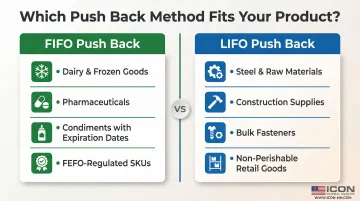
FIFO push back is ideal for:
- Dairy products, condiments, frozen goods, and packaged foods with expiration dates
- Temperature-sensitive medications and products governed by FDA 21 CFR 211.150 regulations requiring oldest-stock-first distribution
LIFO push back is suited to:
- Raw materials, steel components, and work-in-progress inventory that doesn't expire
- Hardware, building materials, and bulk goods where product age doesn't affect value
Cost and System Complexity
LIFO push back is simpler and typically lower-cost to operate — fewer configuration rules, less operational oversight. A single lane can be loaded and unloaded repeatedly without tracking lot codes or dates.
FIFO push back requires more lanes and tighter process discipline. Facilities often need a Warehouse Management System (WMS) to enforce lane rules and prevent mixing old and new product. That adds upfront layout costs and ongoing complexity.
Maintenance and Operational Discipline
FIFO push back demands strict lane discipline: operators must never place new product in a partially filled lane, and the oldest lane must always be picked first. Violations create compliance risk and buried inventory. LIFO push back has fewer procedural requirements — operators simply load and unload from the same face without tracking product age or lot codes, making it easier to train staff and maintain consistency.
What is FIFO Push Back Racking?
FIFO (First In, First Out) in the context of push back racking means the oldest pallet loaded into the system is the first one retrieved. This is not a built-in feature of the rack itself—it's an outcome of how the system is configured and operated. Unlike pallet flow racking, which mechanically enforces FIFO through separate load and unload aisles, push back achieves FIFO through disciplined lane management.
The "FIFO Myth"
Most industry professionals label push back as LIFO because a single lane operates last-in, first-out by design. A forklift loads pallets from one aisle face, and each new pallet pushes the previous one deeper into the lane. When pallets are removed, the most recently loaded pallet comes out first. That label is incomplete. A properly configured multi-lane push back system can achieve full FIFO rotation without any mechanical changes to the rack.
Multi-Lane FIFO Configuration Method
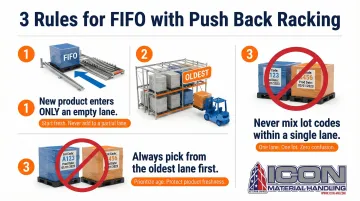
To achieve FIFO with push back racking, three rules must be followed consistently:
- New product always goes into a new, empty lane (never replenish a partially filled lane)
- The oldest lane is always picked first, requiring operators to track which lane was filled earliest
- No mixing of old and new product in the same lane; each lane holds a single lot code or production date
Industry guidelines recommend a minimum of 5-6 pallets per SKU to make FIFO push back operationally viable. Below this threshold, lanes remain underutilized, creating "honeycombing" (empty, unusable positions) that wastes space.
FIFO push back delivers measurable operational advantages:
- Automatic stock rotation without manual repositioning
- Reduced product spoilage and expiry waste
- Compliance with FDA pharmaceutical regulations (21 CFR 211.150) and FSMA traceability requirements
Use Cases of FIFO Push Back Racking
These benefits make FIFO push back the right fit for warehouses where products arrive with lot codes and expiration dates and dispatch order is governed by first-expiry-first-out (FEFO) requirements.
Industries where this configuration is most common:
- Food and beverage: Ketchup, vinegar, sauces, and condiments arriving by the truckload with single lot codes
- Pharmaceuticals: Temperature-sensitive medications requiring strict oldest-stock-first distribution
- Dairy and frozen goods: Products with short shelf lives and high spoilage risk
- FEFO-regulated products: Any SKU where regulatory compliance mandates rotation by expiration date
What is LIFO Push Back Racking?
LIFO (Last In, First Out) in push back racking means pallets are loaded and unloaded from the same aisle face, so the most recently loaded pallet is always the first retrieved. The cart and inclined rail mechanism creates this sequence naturally: each new pallet pushes existing ones back, and as pallets are removed, rear ones flow forward automatically under gravity.
Core Benefits
LIFO push back delivers:
- Cuts forklift travel distance and labor time with single-aisle access
- Eliminates a separate unload aisle — facilities achieve 25-65% greater cubic density than selective racking
- Speeds up batch retrieval for homogeneous, non-date-sensitive products
- Simplifies lane management with no lot codes or date tracking required
LIFO Limitations to Know
That said, LIFO isn't the right fit for every product type. Products with expiration dates or lot-code requirements should not be stored in pure LIFO configuration — older stock gets buried behind newer arrivals, creating compliance risk and potential spoilage. In regulated industries like pharmaceuticals and food, this conflicts with FDA and FSMA traceability requirements.
Use Cases for LIFO Push Back Racking
LIFO push back fits facilities storing products where age sequencing doesn't matter:
- Steel and metal fabrication shops storing raw stock 4-6 pallets deep, accessed in bulk without concern for product age
- Construction supply warehouses holding bulk fasteners, hardware, and building materials with no expiration risk
- Retail distribution for non-perishable goods — packaged paper products, cleaning supplies, and similar high-volume SKUs
FIFO vs LIFO Push Back Racking: Which Should You Choose?
The right configuration depends on five primary factors:
Decision Factors:
- Do your products carry expiration dates, lot codes, or compliance requirements?
- How many pallets of the same SKU do you hold at any given time — fewer than five, or more?
- Is your SKU mix broad with low pallet counts per product, or narrow with high counts?
- Can you afford to dedicate multiple lanes to the same SKU, or is floor space tight?
- Can your team reliably enforce lane discipline without constant supervision?
Choose FIFO Push Back If:
Your products have expiration dates, lot codes, or compliance requirements—and you carry medium-to-high volumes of the same SKU. Industry heuristics recommend a minimum of 5-6 pallets per SKU to make FIFO push back operationally viable without excessive honeycombing. FIFO push back suits food and beverage, pharmaceuticals, dairy, and frozen goods where regulatory compliance mandates oldest-stock-first distribution.
Choose LIFO Push Back If:
Your products are non-perishable, homogeneous, or accessed in bulk batches—and space optimization and aisle reduction are top priorities. LIFO works better when SKU variety is high and per-SKU pallet counts are low, as it doesn't require multiple lanes per product. LIFO push back suits manufacturing raw materials, construction supplies, and retail distribution of durable goods.
Hybrid Scenario:
Many distribution centers use a combination—FIFO push back lanes for perishable or dated products and LIFO push back lanes for durable goods. For example, a 3PL operator might dedicate FIFO lanes to food products requiring strict rotation while running LIFO lanes for non-perishable consumer goods — covering both compliance and density in the same building.
If your facility carries a mix of SKU types or you're unsure which configuration fits your pallet profile, Icon Material Handling can work through the lane design, depth, and inventory method with you before anything gets installed.
Real-World Example: FIFO Achieved with Push Back Racking
A warehouse storing over 5,000 pallets of ketchup and vinegar demonstrates how FIFO can be maintained with push back racking. Products arrived by the truckload, with each truckload containing one SKU and one lot code.
The warehouse used a combination of double-stacked floor storage and push back racking, filling multiple bays and lanes with the same product. The operational rule was simple: never place new product in a partially filled lane—always empty the oldest lane first before refilling.
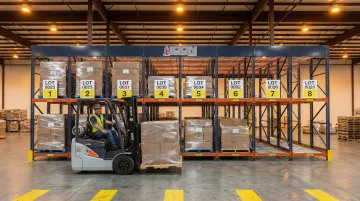
The warehouse maintained FIFO successfully without pallet flow racking or additional infrastructure, purely through disciplined lane management. Push back racking's LIFO designation is a default behavior, not a hard constraint—proper lane discipline opens the door to compliant FIFO rotation.
That same approach applies to any facility handling date-sensitive or lot-controlled inventory. Icon Material Handling can design a push back racking layout built around your specific rotation requirements. Reach the team at Sales@icon-mh.com or call +1 248-971-1455 for a custom solution.
Conclusion
Push back racking is not inherently FIFO or LIFO—it's a high-density system whose inventory method is determined by how it's configured and operated. The right choice comes down to your product type and operational priorities:
- FIFO suits perishable goods, pharmaceuticals, regulated products, or anything date-sensitive with enough SKU volume to justify the system
- LIFO suits durable goods, bulk raw materials, or non-time-sensitive stock where storage density is the primary concern
A well-configured push back system pays for itself through reduced product waste, regulatory compliance, maximum storage density, and lower labor costs. Before committing to a configuration, map your product mix against your rotation requirements—that single decision will determine whether FIFO or LIFO delivers the better return for your facility.
Frequently Asked Questions
Can push back racking really achieve FIFO inventory rotation?
Yes. Push back can achieve FIFO through a multi-lane configuration where new product always enters a fresh lane and the oldest lane is always picked first. The key: never mix dated product within a single lane, and enforce strict picking discipline.
What is the minimum number of pallets per SKU needed to run FIFO with push back racking?
Most operations need at least 5-6 pallets per SKU for FIFO push back to be viable. Match lane depth to your pallet volume per SKU to avoid honeycombing and wasted space.
What is the difference between push back racking and pallet flow racking for FIFO?
Pallet flow racking is purpose-built for FIFO, using gravity rollers to move pallets from the load aisle to the pick aisle automatically. Push back achieves FIFO through lane discipline rather than mechanical face separation — lower cost, but it demands tighter operational controls.
Is LIFO push back racking safe for storing perishable goods?
No, LIFO push back is not recommended for perishables or products with expiration dates. Older stock becomes trapped behind newer product, creating compliance risk and potential spoilage that violates FDA and FSMA regulations.
How deep can push back racking lanes be configured?
Push back racking is available in 2- to 6-deep configurations. Deeper lanes suit high-volume SKUs; shallower lanes work better for lower volumes or broader SKU variety. Most facilities cap at 4-deep due to vertical space constraints.
Which industries benefit most from FIFO push back racking?
Food and beverage, pharmaceutical, dairy, and frozen goods industries benefit most. These sectors require strict stock rotation, lot-code traceability, and compliance with food safety or regulatory standards that mandate oldest-stock-first distribution.