Introduction
Most facility managers don't realize how wide the cost range for rack installation actually is — until they're mid-project and staring down a surprise. Unexpected permitting requirements, inadequate floor conditions, or compliance gaps can all derail a budget that looked solid on paper.
Costs range from roughly $55 per pallet position for a basic selective racking setup to $400 or more for high-density or automated storage and retrieval systems. The gap comes down to rack type, system scale, labor, site conditions, and compliance requirements.
This article breaks down each cost driver, what you're actually paying for, and how to build an accurate budget before you request your first quote.
Key Takeaways
- Selective racking typically runs $55–$200+ per pallet position; double-deep and mid-range systems range from $85–$300+
- Complex or high-density configurations require a custom engineered quote
- Main cost drivers: rack type, system height, labor rates, permitting, and site conditions
- Low-cost rack systems cost less upfront but often carry higher long-term repair and compliance costs
- Professional, fully insured installation reduces rework risk, safety exposure, and operational downtime
How Much Does Warehouse Rack Installation Cost?
Rack installation doesn't follow a fixed price list. The per-pallet-position number you see in a supplier catalog reflects steel components — not the labor, engineering, permitting, freight, or accessories that make up the actual installed cost. Misreading that distinction leads to underbudgeting, or worse, choosing the wrong system entirely.
According to a 2024 ECSE industry guide, the best-supported current benchmarks break down across three tiers:
| Tier | Cost Per Pallet Position | Typical Scope |
|---|---|---|
| Entry-level selective | $55–$200 | Frames, beams, basic labor, minimal accessories |
| Mid-range double-deep or larger selective | $85–$300 | Decking, permitting, professional crew, accessories |
| High-end (pallet flow, push-back, drive-in, automation-compatible) | Quote required | Dynamic components, seismic engineering, compliance packages |
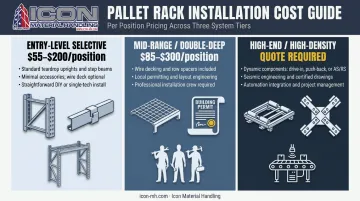
Use the first two ranges as screening numbers, not guarantees. Final pricing depends on inclusions, location, and project scope — which vary significantly.
Entry-Level / Basic Setup
The $55–$200 range covers straightforward selective racking with a basic crew, standard frames and beams, and limited accessories. Permitting is often not required for smaller footprints.
This tier fits:
- Small-to-medium warehouses with simple floor layouts
- Limited SKU variety with predictable picking patterns
- Single-level operations that don't trigger height or compliance thresholds
Mid-Range / Standard Setup
At $85–$300 per position, projects in this range include professional crew labor, wire decking, basic permitting, and seismic or load-capacity engineering where local codes require it.
Typical candidates include:
- Growing distribution centers adding capacity in phases
- Multi-level storage operations with mixed SKU profiles
- Facilities scaling without committing to full automation
High-End / Advanced Setup
High-density systems — pallet flow, push-back, drive-in — don't fit a national per-position benchmark. Costs depend on dynamic components, complex anchoring, compliance engineering, and any integration with conveyors or automation.
These projects typically serve:
- Large fulfillment and high-volume manufacturing environments
- 3PL operations with demanding throughput requirements
- Specialized facilities such as aerospace, defense, or medical device storage
Cisco-Eagle's 2025 rack evaluation guide compares high-density systems by relative cost and operational trade-offs — but not fixed dollar figures. Budget these by engineered quote only. The next question is what drives those quotes higher: the specific cost variables that separate a $55 install from a $300 one.
Key Factors That Drive Up (or Down) Rack Installation Costs
Rack installation costs shift based on technical, operational, and regulatory variables — knowing where the levers are keeps your budget grounded.
Type and Configuration of Racking System
Selective racking is the most cost-effective to install. Drive-in, push-back, pallet flow, and cantilever systems involve tighter installation tolerances, more complex anchoring, and specialized labor — all of which increase total cost considerably.
Accessories add up quickly too:
- Wire decking
- Column guards and row spacers
- Guard rails and end-of-aisle protectors
- Load plaques (required under ANSI MH16.1)
Each adds to the per-position cost, so spec your accessories before requesting quotes.
System Height and Weight Capacity
Taller systems create compounding cost effects:
- High-pile storage permits are triggered when the top of stored material exceeds 12 feet under the 2024 International Fire Code (or 6 feet for high-hazard commodities)
- Heights above 12 feet often require structural engineering sign-offs and fire marshal review
- Structural steel racking (required for heavier loads) costs more than roll-formed alternatives in both materials and labor
Labor and Crew Qualifications
Labor rates vary by region, project complexity, and crew type. Urban markets in the Midwest and coasts typically run higher than rural areas. The distinction between a general contractor and a certified material handling installer also matters. Experienced, insured crews — like Icon Material Handling's installation team serving Michigan, Indiana, Ohio, Wisconsin, and Illinois — cost more upfront but reduce the risk of rework, failed inspections, and safety incidents.
Permitting, Compliance, and Seismic Requirements
Depending on location and system specs, a rack project may require:
- Structural engineering drawings
- Load Application and Rack Configuration (LARC) certifications
- Fire marshal sign-offs
- Seismic analysis (especially in California, the Pacific Northwest, and other high-seismic areas)
California jurisdictions like Los Angeles County require rack plan reviews that include structural calculations, seismic design criteria, anchorage details, and aisle dimensions. Factor permitting costs into your initial budget — not as a contingency line item, but as a fixed expense alongside materials and labor.
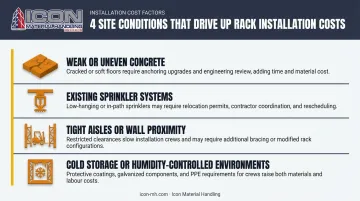
Site-Specific Conditions
Site conditions that increase installation complexity and cost:
- Uneven or weak concrete may require core sampling or reinforcement before anchoring
- Existing sprinkler systems may need reconfiguration when rack heights change
- Tight aisles or wall proximity limit equipment access and slow installation
- Cold storage or humidity-controlled environments require galvanized or corrosion-resistant materials — galvanized rack typically costs more than standard powder-coated alternatives
The Full Cost Breakdown: What You're Actually Paying For
The purchase price of the rack components is just the starting point. A realistic project budget includes:
One-Time Costs:
- Rack components: Teardrop upright frames typically run $74–$276 each; beam pairs range from $34–$210 depending on size and capacity. Used racking can cut equipment costs by 30–50% compared to new — condition inspection is non-negotiable before purchase.
- Installation and labor: Crew wages, scissor lift or elevated platform rental (typically $100–$150/day for indoor lifts), transportation, and project management. Icon Material Handling's installation team is fully insured and handles the full process, which matters in facilities where jobsite liability is a real concern.
- Permitting, engineering, and compliance: Structural drawings, CAD layouts, permit applications, inspections, and seismic or fire compliance engineering. No single national benchmark exists for this category — costs vary by jurisdiction, system height, and commodity type. Budget this line item early, not as a late-stage add-on.
Recurring Costs:
- Rack inspections: ANSI/RMI standards call for annual inspections at minimum; high-traffic facilities often need quarterly checks.
- Impact repairs: Forklift strikes are the leading cause of rack damage. Roll-formed systems absorb impacts less well than structural steel, so repair frequency is higher in busy facilities.
- Reconfiguration: As inventory mix changes, beam heights and bay layouts need adjustment — factor in periodic labor costs for this, not just initial setup.
A practical estimating formula: rack components + accessories + freight + installation labor and equipment + engineering and permits + seismic and anchorage + load plaques + inspection and repair contingency.
Budget vs. Premium Installation — What's the Real Difference?
Budget and premium installations differ in more than sticker price. The real gap shows up in safety margins, code compliance, and total cost over the system's life.
| Dimension | Budget Installation | Premium Installation |
|---|---|---|
| Steel type | Roll-formed, lighter gauge | Structural steel, higher impact tolerance |
| Damage resistance | More susceptible to forklift impacts | Longer service life, fewer repairs |
| Compliance | May lack engineered drawings or seismic analysis | Full engineering package, load-certified from day one |
| Inspection risk | Higher chance of failing local plan review | Code-compliant; designed to pass review |
| Long-term cost | Lower upfront, higher repair frequency and earlier replacement | Higher upfront, lower lifecycle cost overall |
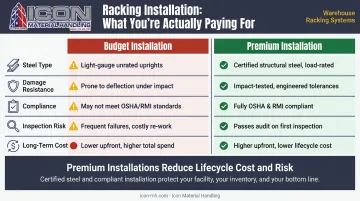
Compliance failures have a direct price tag. OSHA has issued citations for struck-by and crushed-by hazards involving pallet racks, with one cited penalty reaching $7,000. Cutting corners on anchoring, engineering review, or qualified installation can cost far more in enforcement actions, liability exposure, and unplanned downtime than the upfront savings ever justified.
How to Estimate the Right Budget for Your Rack Installation Project
Accurate budgeting starts before you contact a single vendor. The factors you define upfront determine which costs appear in your quote — and which ones catch you off guard later.
Define these before requesting quotes:
- Intended load capacity and pallet dimensions
- Number of pallet positions and storage levels needed
- Building height, floor condition, and existing obstructions
- Location-specific permitting and seismic requirements
- Whether new or used equipment fits your timeline and budget
Icon Material Handling offers both new and used racking options — uprights, teardrop beams, wire decks — with professional installation across Michigan and bordering states, giving facilities flexibility in balancing upfront cost and system quality.
Once you have those inputs ready, it's equally important to know where budgets typically go wrong.
Common budgeting mistakes to avoid:
- Focusing only on per-pallet-position cost while ignoring installation, permitting, and compliance
- Choosing the cheapest installer without verifying insurance, certifications, and references
- Failing to plan for operational downtime during installation
- Underestimating future expansion needs that may require costly reconfiguration later
Facilities that get quotes from multiple vendors — and ask each one to itemize materials, labor, permitting, and compliance separately — consistently avoid the budget overruns that derail projects mid-installation.
Frequently Asked Questions
How much does it cost to install racking?
Selective racking typically runs $55–$200 per pallet position; double-deep systems run $85–$300. Final cost depends on rack type, project scale, labor rates, and whether permitting or engineering is required. High-density systems like pallet flow or push-back require custom engineered quotes.
Do you need to be qualified to install racking?
Professional installation is strongly recommended and often required by local codes and manufacturer warranties. Certified, insured crews ensure compliance with load ratings, seismic standards, and OSHA material storage requirements — protecting the facility when inspections occur.
How long does warehouse rack installation take?
Small projects typically take 1–2 days; medium builds run 3–5 days; large or complex installations can take one to several weeks.
Does warehouse rack installation require permits?
Permits are commonly required when racks exceed 12 feet in height, involve high-pile combustible storage, or are in jurisdictions with seismic regulations. Skipping permits can result in fines, mandatory teardowns, or failed inspections.
Is used warehouse racking cheaper to install than new?
Used racking typically costs 30–50% less than new at the equipment level, while installation labor costs are comparable. Inspecting used components for damage before installation is essential to confirm structural integrity and compliance.
What hidden costs should I expect in a rack installation project?
The most commonly overlooked costs are:
- Permits and engineering drawings
- Scissor lift or platform rental
- Crew transportation
- Compliance upgrades (fire suppression or egress changes)
- Load plaques
- Operational downtime during installation