Introduction
Over 425 million square feet of industrial space was completed in the US in 2024 alone, according to Cushman & Wakefield's Q4 2024 Industrial MarketBeat. Much of that space lands in tenants' hands as an empty shell — and turning it into a functional warehouse requires a fit-out investment that is separate from, and routinely underestimated next to, rent and equipment purchases.
Fit-out costs vary enormously. A basic racking-and-lighting job in a partially finished space looks nothing like a purpose-built distribution center with automation, mezzanines, and fire suppression upgrades. The cost difference comes down to three things: the starting condition of the space, what you're storing, and how product moves through the facility.
This guide covers:
- Realistic US cost ranges broken down at the component level
- The three fit-out starting conditions (Shell & Core, Cat-A, Cat-B)
- Key factors that push costs up or down
- A framework for building a budget that holds through the project
Key Takeaways
- Basic warehouse fit-outs run roughly $10–$25/sq ft; high-spec or automated configurations can reach $50–$100+/sq ft
- The biggest cost drivers are the starting condition of the space, racking system type, facility size, and automation level
- Automation is a separate budget category entirely — AS/RS systems alone start at $750,000+, on top of standard facility finishing costs
- Only itemized, component-level quotes give you a reliable budget — ballpark estimates won't cut it
How Much Does a Warehouse Fit-Out Cost?
There is no single national benchmark for warehouse fit-out cost per square foot. Unlike ground-up construction — where Cushman & Wakefield's Industrial Construction Cost Guide puts averages at $85–$139/sq ft depending on project size — fit-out costs depend on too many facility-specific variables to publish a single reliable number.
What's verifiable is the component cost picture. Fit-out budgets break down into three tiers:
Entry-Level / Basic Setup
For a warehouse moving into a partially finished space (Cat-A condition), a basic fit-out covering selective pallet racking, epoxy flooring, and LED high-bay lighting typically runs in the $10–$25/sq ft range for a 10,000–25,000 sq ft facility. This assumes no mezzanines, no automation, and no major HVAC or electrical upgrades.
What's typically included:
- Selective pallet racking
- Basic flooring (epoxy coating or line marking)
- LED high-bay fixture installation
- Safety barriers and column guards
- Minimal partitioning
What's excluded: Land, structural modifications, HVAC replacements, fire suppression redesigns, and any automation hardware or software.
Mid-Range / Standard Fit-Out
A mid-range scope adds mezzanines, dock equipment, guardrails, more complex racking configurations, and code-review costs. Expect $25–$50/sq ft for a 25,000–50,000 sq ft facility with these components, though site-specific factors (floor flatness, column spacing, ceiling height) can push costs toward either end.
High-End / Automated Fit-Out
Once conveyors, AS/RS, or robotics enter the picture, cost structures shift from finishing work to capital investment. Automation is priced as an integrated system — not a line item:
| System Type | Starting Investment |
|---|---|
| Mini-load AS/RS | $750,000+ |
| Unit-load AS/RS | $1,000,000+ |
| Multi-shuttle systems | $1,000,000+ |
| Robotic cube storage | $1,500,000+ |
| Conveyor systems | $10,000–$400,000+ |
These figures come from Kardex's AS/RS cost analysis and represent starting points before integration, controls, and WMS costs are added.
Shell and Core, Cat-A, and Cat-B: Why the Starting Point Matters
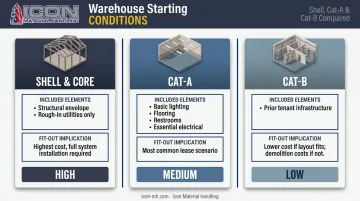
The condition of the space you're moving into is one of the largest single variables in any fit-out budget. Each starting condition carries a different baseline — and a different cost floor.
| Condition | What's In Place | Fit-Out Implication |
|---|---|---|
| Shell & Core | Bare structural envelope — no finishes, no lighting, utilities at rough-in only | Highest cost: design and install the full stack (electrical, HVAC, fire suppression, flooring, storage systems) |
| Cat-A | Functional baseline — basic lighting, flooring, restrooms, essential electrical | Most common lease scenario; add racking, dock equipment, partitioning, and specialist systems |
| Cat-B | Prior tenant's infrastructure in place | Lower cost if the layout fits your operation; demolition and reconfiguration costs apply if it doesn't |
Key Factors That Affect the Cost of a Warehouse Fit-Out
Before requesting quotes, understanding what moves the number up or down prevents the most common budgeting mistakes.
Type and Level of Fit-Out Required
The starting condition of the space directly affects scope. A Shell & Core project can cost three to five times more per square foot than adapting a Cat-A space, because you're paying for every system in the facility rather than just the storage layer on top. When evaluating any facility, assess what's already installed and what it would cost to modify or remove it.
Size and Layout of the Warehouse
Fit-out costs are calculated per square foot, so larger facilities cost more in total. However, larger projects often benefit from per-square-foot economies of scale on racking and labor: the design cost spreads across more usable space. Complex layouts with narrow aisles, multiple pick zones, or irregular footprints increase both design time and installation cost regardless of total area.
Type of Storage System and Racking Required
Racking is typically the largest single line item in a fit-out. Common system types and their cost characteristics:
| System Type | Cost Characteristic |
|---|---|
| Selective pallet rack | Lowest per-bay cost; widest availability in new and used |
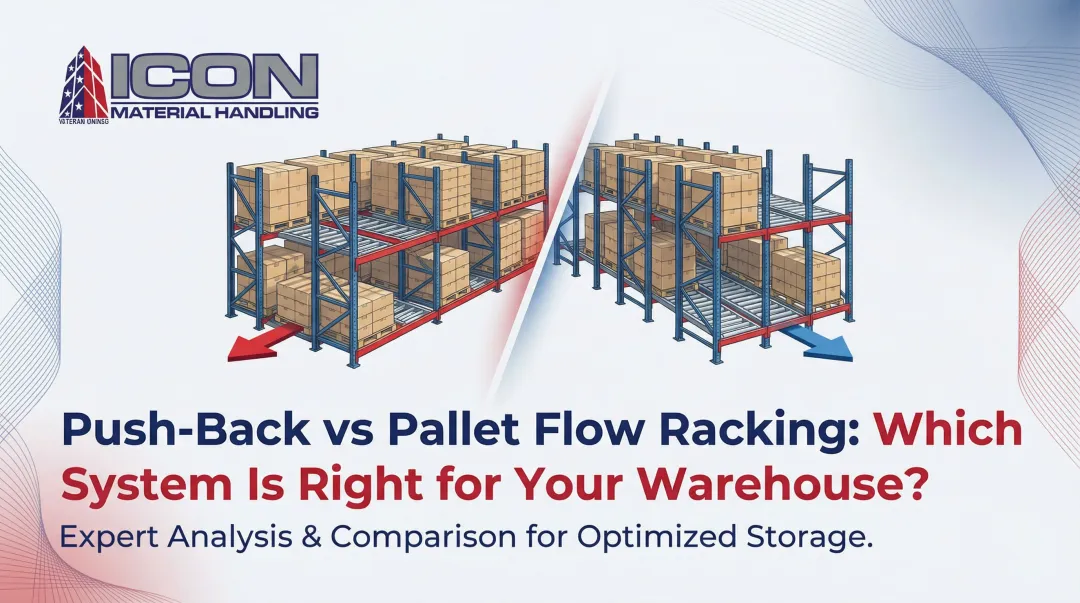
| Push-back rack | Higher density; higher upfront cost than selective |
| Drive-in rack | Very high density; requires engineered layout |
| Cantilever rack | Suited to long or irregular items; cost depends on arm length and load |
| High-bay / VNA rack | Requires specific forklift equipment; ceiling height determines feasibility |
Icon Material Handling supplies both new and used versions of push-back, pallet flow, drive-in, and cantilever systems — an option worth evaluating for budget-sensitive projects where used equipment can meaningfully reduce upfront racking costs.
Level of Automation and Technology
Manual pick-and-pack operations need only racking and labor. As throughput requirements grow, conveyors, WMS software, and automated retrieval systems enter the picture, each with its own cost and capacity tradeoff.
The 2025 Modern Materials Handling automation survey found that software and controls are now a standard budget category for mid-sized operations:
- 63% use a warehouse management system (WMS)
- 60% use conveyor or sortation equipment
- 41% use shuttle systems or mobile robotic storage
Installation, Compliance, and Site-Specific Requirements
Labor and installation represent a substantial share of total fit-out cost. For mezzanines, installation labor typically runs 30–50% of material cost. For guardrails, installation is often estimated to equal material cost.
Those labor figures don't include compliance costs, which are non-negotiable regardless of project size:
- OSHA 1910.176 requires stored material not create a hazard and that tiers are stacked, blocked, and height-limited
- ANSI MH16.1 sets load capacity requirements for pallet rack
- NFPA 13 fire suppression requirements change based on storage height, commodity type, and rack configuration; a racking change can trigger a full sprinkler redesign
Budget for engineering review and fire protection assessment before ordering racking. Ignoring this step creates expensive surprises after equipment is on-site.
Complete Cost Breakdown of a Warehouse Fit-Out
Racking and Storage Systems
The largest single budget line for most fit-outs. Cost varies by system type, height, load capacity, and whether new or used equipment is sourced.
Component-level reference prices (equipment only, not installed):
- Selective pallet rack starter kits (12–14 ft, 3 levels): $354–$586
- Used push-back rack systems (2–3 deep): $184–$211 per section
- Cantilever rack bases (light-duty): $68–$113 per component
Full installed system costs require layout-specific quotes, as aisle configuration, clear height, and column placement all affect pricing.
Flooring, Lighting, and Safety Systems
Often underestimated in early budgets, these items are essential for compliance and daily operations.
- Epoxy flooring (materials only): $0.63–$2.79/sq ft depending on system type and layers
- Contractor-installed epoxy: approximately $5–$8/sq ft
- LED high-bay fixtures: $100–$1,000 per fixture (fixture price only; installation is additional)
- Guardrails (materials): $35–$71 per linear foot for single or double-high
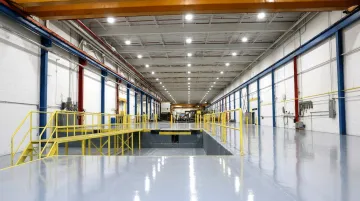
Safety systems — column guards, end-of-row guards, bollards, machine guards — are required under OSHA requirements and protect both people and infrastructure.
Mezzanine Floors and Partitioning
Mezzanines add usable floor area without expanding the building footprint — often the most efficient use of vertical space in a constrained facility. Material costs typically run $40–$250+/sq ft, with installation labor adding approximately 30–50% on top of materials. Freight often adds another 10%.
That wide range reflects differences in load rating, span, surface finish, and access configuration. Icon Material Handling designs and fabricates custom mezzanines for specific facility layouts, including irregular floor plans and non-standard load requirements.
HVAC, Electrical, and Fire Protection
These systems rarely make it into early fit-out estimates and cause mid-project budget overruns.
- Electrical service upgrades: $15,000–$150,000+ depending on amperage, three-phase conversion, and existing infrastructure condition
- Fire suppression modifications: Cost depends on storage configuration, commodity class, and rack height — not square footage alone
- HVAC: Must be calculated from engineering load data, not floor area, particularly for facilities with 32 ft+ clear height
Any project adding automation, conveyor systems, or EV charging stations for forklifts should include an electrical capacity review before finalizing equipment budgets.
Ongoing Maintenance and Operational Costs
Installation is the starting point, not the finish line. Budget for these recurring costs:
- Annual racking inspection and re-certification
- Floor maintenance (epoxy recoating cycles)
- Lighting upkeep and replacement
- Periodic reconfiguration as inventory mix or throughput changes
Heavier-gauge racking, engineered layouts, and quality flooring systems typically extend recoating and reconfiguration cycles — meaning the upfront premium on better equipment often pays back within 3–5 years of reduced maintenance spend.
Low-Cost vs. High-Cost Warehouse Fit-Out: What's the Difference?
The right fit-out tier depends entirely on throughput, product type, and growth plans — not just available budget.
| Dimension | Budget Fit-Out | Premium / Automated Fit-Out |
|---|---|---|
| Performance | Manual picking, basic flow | Optimized zones, automated retrieval |
| Durability | Standard-gauge racking | Heavy-duty certified systems |
| Maintenance | Frequent reconfiguration | Purpose-built, stable layout |
| Labor cost | Higher over time | Reduced through automation |
| Upfront cost | Lower | Significantly higher |
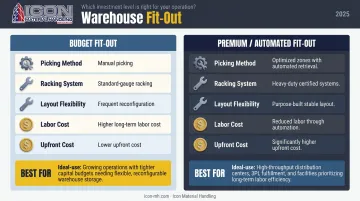
Budget fit-outs make sense for:
- Startups and small operations with limited SKU counts
- Short-term leases or seasonal storage needs
- Businesses with predictable, low-volume throughput
Consider a premium setup when:
- Distribution centers and 3PL fulfillment operations with high daily order volumes
- Operations where labor costs make automation ROI achievable within 1–3 years
- Facilities storing high-value, fragile, or compliance-sensitive inventory
KNAPP estimates AMR payback at 1–3 years depending on labor costs, travel distances, and throughput. For multi-shift operations with heavy pick labor costs, the upfront investment in automation typically pays for itself — and then some.
How to Estimate the Right Budget for Your Warehouse Fit-Out
The right budget isn't the lowest possible number — it's the one that matches your operational requirements without requiring a costly reconfiguration within two to three years.
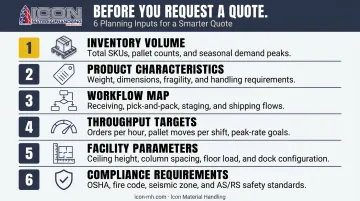
Before Requesting Quotes, Gather These Inputs
- Current and projected inventory volume — SKU count, pallet positions needed, seasonal peaks
- Product characteristics — weight, dimensions, fragility, any regulatory storage requirements
- Workflow map — inbound receiving, storage zones, pick/pack, outbound staging
- Throughput targets — orders per day, units per hour
- Facility parameters — clear height, floor load capacity, column grid, dock positions
- Compliance requirements — industry-specific standards (FDA, aerospace, food-grade)
What to Ask For in a Quote
Request an itemized quote that breaks out:
- Equipment costs (racking, mezzanines, safety systems) by line item
- Installation labor separately from equipment
- Engineering and design fees
- Removal or demolition of existing systems (if applicable)
- Freight and delivery
Allow a 10–15% contingency for scope changes and unforeseen site conditions. Floor flatness problems, utility conflicts, and permit delays are common once a project is underway — budgeting for them upfront avoids mid-project surprises.
Icon Material Handling provides itemized quotes covering both new and used equipment across Michigan, Indiana, Ohio, Wisconsin, and Illinois, with custom design and professional installation included.
Common Mistakes That Blow Warehouse Fit-Out Budgets
- Budget for installation alongside equipment — not after. Mezzanine installation adds 30–50% on top of material cost; guardrails often run dollar-for-dollar with materials. These aren't optional line items.
- Order racking only after your fire review is complete. NFPA 13 requirements shift based on storage height, commodity type, and rack configuration — locking in equipment before that review risks a costly sprinkler redesign.
- Skipping load rating and compatibility checks on low-cost racking creates a false economy. Substandard systems fail early and rarely adapt to future configurations, turning a small saving into a larger replacement cost.
- Match the solution to the actual operation. Full automation for a 500-SKU, low-volume business is wasteful; selective racking with no expansion room means a forced reconfiguration in 18 months.
- A higher upfront investment in quality racking, energy-efficient lighting, and engineered layouts delivers a lower cost per pallet position over the facility's life — the math favors quality.
Conclusion
Warehouse fit-out costs in the US span a wide range — from roughly $10/sq ft for basic racking and lighting in a partially finished space, to $100+/sq ft for automated, purpose-built distribution environments. The gap between those numbers comes down to starting conditions, storage system choices, and operational complexity.
Understanding each cost component — storage systems, flooring, lighting, mezzanines, electrical, compliance — leads to more accurate budgets and fewer mid-project surprises. The businesses that underbudget typically do so because they price equipment without installation, ignore compliance review costs, or treat automation as a simple line item rather than a system-level investment.
The right fit-out is the one that matches your operational requirements today, leaves room for growth, and doesn't require expensive reconfiguration within the next few years. Working through those tradeoffs early — and exploring both new and used equipment options — often makes the difference between a budget that holds and one that doesn't. Icon Material Handling supplies racking systems, mezzanines, conveyors, and automation solutions across the US, with installation services included, if you're ready to start scoping your project.
Frequently Asked Questions
How much does it cost to fit out a warehouse?
US warehouse fit-out costs typically range from around $10/sq ft for basic setups to $100+/sq ft for fully automated configurations. Actual cost depends on the starting condition of the space, the storage systems required, and whether automation is part of the scope.
How much does it cost to fit out a warehouse per square foot?
Basic fit-outs covering racking, lighting, and flooring generally run $10–$25/sq ft. Mid-range scopes with mezzanines, dock work, and code compliance typically fall in the $25–$50/sq ft range. Automated configurations exceed $50/sq ft, often substantially, once AS/RS or conveyor systems are included.
What is included in a warehouse fit-out?
A full-scope fit-out covers racking, flooring, LED high-bay lighting, mezzanines, partitioning, dock equipment, electrical and HVAC upgrades, fire protection, and safety barriers. A basic fit-out is limited to racking, flooring, lighting, and essential safety products.
What is the difference between a Cat A and Cat B warehouse fit-out?
Cat-A provides a functional baseline: lighting, flooring, and utilities are in place, but racking and specialist equipment still need to be added. Cat-B retains the previous tenant's infrastructure, which either reduces costs if it suits your operation or adds demolition costs if it doesn't.
How long does a warehouse fit-out take?
Basic racking installations take days to a few weeks. Full fit-outs covering mezzanines, electrical upgrades, and automation typically run 4–16 weeks, with planning, permitting, and engineering review adding time before physical work begins.
Can buying used warehouse racking and equipment reduce fit-out costs?
Yes — quality used racking can meaningfully cut upfront equipment costs. The key is ensuring that used systems are load-rated, structurally sound, and professionally installed. Suppliers like Icon Material Handling offer both new and used racking options, so operations can control costs without compromising on load ratings or safety.