Introduction
Michigan's warehouses and manufacturing facilities are under real pressure. The smart warehousing market is projected to grow from $31.21 billion in 2025 to $46.42 billion by 2030 — an 8.3% annual growth rate — and Michigan sits at the center of that demand. With 96 of the top 100 North American auto suppliers maintaining a Michigan presence and the state producing nearly 19% of all U.S. auto output, operators here face concrete pressure to move faster, cut errors, and reduce dependence on manual labor.
Automation pricing, though, confuses most operators before they even start. Costs range from $10,000 for a basic conveyor setup to $25 million or more for a fully integrated robotic facility — and the right number depends entirely on what you're trying to solve.
What follows covers realistic pricing tiers, the key cost drivers specific to Michigan warehouses, and what a complete automation budget actually includes — so you can estimate the right investment without over-specifying or undershooting.
Key Takeaways
- Entry-level automation (conveyors, barcode systems, basic WMS) runs $10,000–$50,000 for targeted solutions
- Mid-range systems (AS/RS, sortation, robotic picking) start at $70,000 and scale past $1 million
- Advanced or facility-wide automation reaches $500,000–$25 million+ for large operations
- Annual maintenance adds 15–20% of equipment cost — budget for it upfront
- Budget by throughput volume and operation size, not by price tier alone
How Much Does Warehouse Automation Cost? Pricing Overview
There is no fixed price for warehouse automation. What you spend depends on the technologies you choose, your facility's current condition, and how much of your operation you want to automate.
Two common mistakes happen early. Some operators underbudget and end up with a partial implementation that doesn't solve the problem. Others choose based on price alone, only to find the system can't handle their order volume or won't connect to their existing WMS. Both errors are expensive to fix. Here's what each tier actually costs.
Entry-Level Automation: $10,000–$50,000
This tier covers point solutions: equipment that addresses a specific bottleneck rather than automating an entire facility.
Typical entry-level components include:
- Motor-driven roller conveyors (approximately $1,500 per linear foot installed)
- Basic barcode scanners (industrial Zebra units list around $989 per unit)
- Simple inventory management or entry-level WMS software
- Gravity feed and belt conveyor sections
Best for: Small Michigan warehouses and manufacturers taking their first step into automation. Operations with manageable SKU counts, predictable order volumes, and a specific manual process they need to fix.
Mid-Range Automation: $70,000–$1,000,000+
This is where facility-level thinking begins. Mid-range systems don't just improve one process — they start changing how inventory moves and how labor is deployed.
What this tier includes:
- Automated Storage and Retrieval Systems — vertical carousels from $70,000+, vertical lift modules from $95,000+, vertical buffers from $180,000+
- Mini-load AS/RS from $750,000+, unit-load and multi-shuttle systems from $1 million+
- Automated sortation equipment ($10,000–$250,000, with large facilities exceeding $1 million)
- Robotic assistance for picking and packing (case packing lines run roughly $150,000–$300,000+)
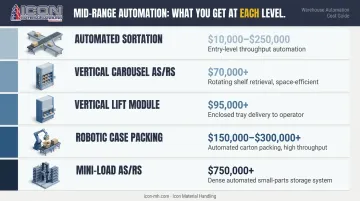
Best for: Growing Michigan distribution centers and fulfillment operations facing rising order volumes that need to reduce reliance on manual labor without a complete facility overhaul.
High-End and Advanced Automation: $500,000–$25,000,000+
At this level, automation becomes a facility-defining investment — not a supplement to existing workflows but a replacement of them.
This tier covers:
- Autonomous Mobile Robots (AMRs), Automated Guided Vehicles (AGVs), and collaborative robots (cobots)
- Facility-wide AS/RS including robotic cube storage systems ($1.5 million+)
- AI-driven WMS with deep ERP integration
- Lights-out "dark warehouse" configurations for high-volume operations
Large, highly automated facilities in this tier typically run $5 million–$15 million+.
Best for:
- Large Michigan manufacturers and major distribution centers with high daily throughput
- Aerospace and defense suppliers with complex inventory profiles
- Operations with capital available for long-term labor savings
Key Factors That Affect the Cost of Warehouse Automation
The final number depends on a combination of technical, operational, and facility-specific variables. Understanding each one prevents budget surprises.
Type of Technology
Not all automation technologies are priced in the same universe. Here's how the categories stack up:
| Technology | Approximate Cost Range |
|---|---|
| Conveyor systems | ~$1,500/linear foot installed |
| Basic barcode scanning | ~$989–$2,000/unit |
| AMRs | $30,000–$100,000 per unit |
| Cobots | ~$45,000–$55,000 per unit (before end effectors and integration) |
| Vertical carousel AS/RS | $70,000+ |
| Robotic cube storage AS/RS | $1.5 million+ |
A note on cobots: the frequently cited $20,000–$50,000 range understates what most mainstream models actually cost. Popular units from UR, Dobot, and Techman typically land closer to $45,000–$55,000 before you add end effectors, safety equipment, and integration costs.
Warehouse Size and Layout
Larger facilities need more automation units, more extensive wiring and networking, and more sophisticated coordination software. AS/RS installations, for example, require:
- 200–400 amps of electrical capacity in many configurations
- At least 18 inches of ceiling clearance above the unit for HVAC and fire safety equipment
- Fire suppression systems costing $50,000–$200,000 depending on configuration
Michigan's older industrial buildings — common in automotive supplier corridors — frequently require additional site preparation that newer facilities don't. Narrow-aisle layouts, multi-level mezzanines, and aging electrical infrastructure all add cost before a single robot is installed.
Level of Automation and Customization
Standard solutions deploy faster and cost less upfront — but they're built for average workflows. When a facility handles unusually shaped products, regulated inventory (medical devices, aerospace components), or complex multi-zone picking, a standard configuration often creates new bottlenecks rather than eliminating them.
For Michigan's diverse manufacturing base — including aerospace, defense, and medical device clients — custom automation frequently delivers better long-term ROI precisely because the operation doesn't fit a standard mold. Icon Material Handling designs custom-built automation solutions, including AS/RS and robotic picking systems, tailored to the specific inefficiencies standard equipment can't resolve.
System Integration Requirements
Connecting new automation to an existing ERP or legacy WMS adds real cost — often more than operators expect. Older systems may lack standardized communication protocols, requiring custom middleware or API development.
First-year WMS costs can reach $50,000 to over $2 million depending on scope and complexity; enterprise on-premises setups frequently run $100,000–$500,000 for initial configuration alone. Budget for integration as its own line item — not an afterthought folded into equipment costs.
Maintenance, Support, and Workforce Costs
Annual maintenance typically runs 15–20% of initial equipment cost. On a $500,000 system, that's $75,000–$100,000 per year — a recurring operational expense, not an occasional one.
Staff adaptation also carries a cost. While AMR-integrated teams have seen training time drop dramatically (one reported case reduced onboarding from a week to under an hour), the transition period still requires investment. Budget for workforce changes during implementation, not just after.
Full Cost Breakdown: One-Time and Recurring Expenses
Hardware is just the start. Most facilities underestimate total project cost by 30–50% because they budget for equipment alone — and miss the installation, software, and ongoing operational expenses that follow.
One-Time Costs
Initial Equipment Purchase The largest single cost is physical hardware: robots, conveyors, racking, AS/RS units, and sensors. Both new and used equipment are viable here. Used conveyor sections, racking systems, and select AS/RS components can reduce upfront costs substantially — Icon Material Handling stocks both new and used warehouse equipment to give facilities that flexibility.
Installation, Site Preparation, and Training Professional installation and commissioning commonly adds 20–30% to the equipment purchase price — and some projects reach 20–40% when extensive infrastructure work is required. Budget separately for:
- Reinforced flooring and concrete work
- Electrical upgrades (200–400 amp capacity for AS/RS)
- Network infrastructure
- Fire suppression systems ($50,000–$200,000 for AS/RS)
- Staff onboarding and system training
Recurring Costs
Software Licensing and WMS Tier 1 WMS license fees run $30,000–$100,000, with annual maintenance at 10–15% of the license cost for on-premises systems. Cloud-based WMS uses subscription pricing. Budget for WMS as a range, not a fixed line item — costs vary widely by provider, scope, and whether integration is included.
Maintenance and Technical Support Treat 15–20% of equipment value annually as a fixed operational line item. Tiered service contracts from vendors can make this more predictable. Note that Icon Material Handling does not offer maintenance contracts, so confirm service coverage with your automation vendor before finalizing any agreement.
Periodic Upgrades and Component Replacements Automation systems don't stay static. Plan capital reserves for:
- Conveyor belts and drive components (typically every 3–5 years under heavy use)
- Robot end-of-arm tooling and sensors
- WMS version upgrades and compatibility patches
- Full hardware refreshes at the 7–10 year mark
Facilities that treat upgrades as a surprise expense — rather than a scheduled line item — tend to face the most disruptive downtime.
Low-Cost vs. High-Cost Warehouse Automation: What's the Difference?
The price gap between entry-level and advanced automation reflects genuine operational differences, not just a longer feature list. Here's where the gap actually shows up:
- Throughput capacity: Entry-level systems handle basic tracking and directed movement. High-end cube storage systems have reported labor reductions of 80%, floor-space savings of 90%, and capacity increases up to 10x over non-automated storage.
- System uptime: Advanced integrated systems target 99.7% uptime with redundant infrastructure. A single failure in an entry-level conveyor or scanner setup stops the entire process.
- Scalability: Fixed conveyor layouts can't adapt to new SKUs or volume spikes without physical modifications. AMR fleets and AS/RS systems scale by adding units or adjusting software — no construction required.
- Maintenance structure: Entry-level equipment is simpler to service but comes with no vendor support infrastructure. Advanced systems carry higher annual maintenance costs and typically include structured contracts with remote diagnostics.
- Return on investment: AS/RS systems have demonstrated sub-12-month payback in vendor surveys. One MHI case study documented a Michigan-area automotive supplier cutting forklift labor by 30%, with projected savings of $4.2 million over three years.
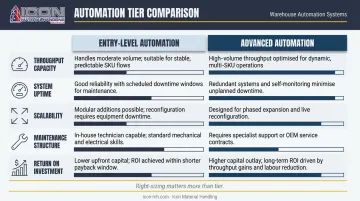
Higher cost doesn't automatically mean better fit. A smaller Michigan warehouse processing 200 daily orders with a stable SKU count that installs an enterprise AS/RS system is paying for capabilities it won't use for years. Right-sizing matters more than tier.
How to Estimate the Right Budget for Your Michigan Warehouse
The most effective budget starts with operational need, not a price point. Before estimating any number, answer these questions:
- Which repetitive tasks consume the most labor hours — and what do those hours cost annually?
- What is your current error rate, and what does rework and returns cost per month?
- Is the facility planning significant volume growth in the next 3–5 years?
- Do you serve automotive, aerospace, or medical device clients with specific throughput or traceability requirements?
- Are there seasonal volume spikes that currently require temporary labor you can't always source?
Using Total Cost of Ownership (TCO)
Add these components for a realistic multi-year cost picture:
- Initial equipment — hardware at published or quoted cost
- Installation and site prep — add 20–30% (or up to 40% for older Michigan industrial buildings with non-standard layouts)
- Software/WMS — $30,000–$500,000+ depending on tier and integration scope
- Annual maintenance — 15–20% of equipment cost, every year
- Energy and utility increases — automated systems often draw considerably more power than manual operations
- Training — staff transition costs during implementation
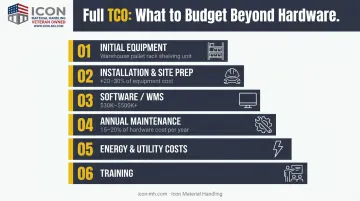
Compare this total against projected labor savings, throughput gains, and error reduction to estimate your payback period. Simpler systems like conveyors and basic WMS can recover costs quickly. Complex AS/RS or fully integrated robotic systems typically take longer — but the cumulative savings over a 5–10 year lifecycle are often 3–5× the upfront investment.
Working with a local specialist cuts estimation time and surfaces site-specific costs early. Icon Material Handling designs custom automation solutions for Michigan warehouses and manufacturing facilities — from conveyor systems and racking to fully custom-built automated setups — and can help scope projects based on your specific facility conditions rather than generic benchmarks.
What Most Michigan Facilities Get Wrong About Automation Costs
- Ignoring maintenance, software, and energy costs that accumulate across the system's lifecycle — purchase price is only the starting point
- Choosing the cheapest option without verifying it can handle actual throughput or integrate with existing systems, leading to costly retrofits
- Over-specifying technology that exceeds current operational needs, tying up capital in capabilities the facility won't use for years
- Leaving the temporary productivity dip during implementation out of the ROI calculation — that transition cost is real and belongs in the math from day one
Frequently Asked Questions
Frequently Asked Questions
How much does warehouse automation cost?
Costs range from $10,000–$50,000 for entry-level conveyor and scanning systems to $500,000–$25 million+ for advanced or facility-wide automation. The right number depends on technology type, warehouse size, and degree of customization required.
What is the typical ROI timeframe for warehouse automation?
It varies by system complexity. AS/RS vendor data shows 80% of surveyed customers saw ROI within 12 months, while more complex robotic implementations take longer — one automotive supplier case study projected $4.2 million in cumulative savings over three years.
Can warehouse automation be implemented in phases to manage costs?
Yes, and it's a common approach. Starting with high-impact areas like picking or receiving lets initial investments generate returns before expanding — and gives your team time to build expertise before scale increases.
What are the most affordable warehouse automation options?
The lowest-cost entry points are motor-driven roller conveyors ($1,500/linear foot), industrial barcode scanners ($989/unit), and basic WMS software. These deliver measurable efficiency gains without requiring million-dollar commitments.
How does warehouse size affect automation costs?
Larger facilities need more equipment units, more extensive electrical and network infrastructure, and more complex coordination software — all of which multiply costs. That said, very large operations can benefit from economies of scale on a per-square-foot basis.
Are there hidden costs that warehouse automation companies often overlook?
The most commonly missed costs are facility modifications (flooring, electrical, fire suppression), legacy system integration, extended training programs, temporary productivity loss during implementation, and annual maintenance running 15–20% of equipment value.