Two technologies compete for that budget: conveyor sortation systems and robotic sorter systems. Both reduce manual labor. Both improve throughput. But they do it in fundamentally different ways, and choosing the wrong one for your facility's operational profile is an expensive mistake.
This guide breaks down the real cost differences — upfront investment, maintenance exposure, scalability, and total cost of ownership — so Michigan operators can make an informed decision rather than a vendor-driven one.
Key Takeaways
- Conveyor sorters deliver unmatched throughput for high-volume operations, but carry significant upfront capital and fixed infrastructure costs
- Robotic systems (AMR-based) are modular and reconfigurable, with lower entry costs and phased investment options
- Base the decision on total cost of ownership over 5–10 years, not sticker price
- Michigan's automotive, 3PL, and medical device sectors each have distinct sorting profiles that favor one approach
- Hybrid systems are gaining ground in mid-sized Michigan operations: conveyors for bulk flow, robots for flexible last-stage sorting
Conveyor vs. Robotic Sorter Systems: At a Glance
The tables below give you a side-by-side snapshot of how these two system types compare on cost structure, throughput, and flexibility. Note that MHI confirms total cost inputs span design, capital equipment, installation, commissioning, maintenance, and spare parts — so any figure without a site-specific quote behind it is a rough estimate. The comparative picture, however, is clear enough to plan around.
Upfront Investment
| Factor | Conveyor Sorter | Robotic Sorter |
|---|---|---|
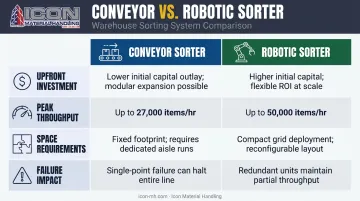
| Capital structure | High upfront, all-in | Lower entry, scalable by adding units |
| Installation complexity | High — fixed infrastructure, long lead times | Lower — modular deployment, weeks rather than months |
| Cost drivers | Equipment, integration, building modifications | Robot fleet size, induction stations, software |
| Budget approach | Single capital event | Phased investment possible |
Throughput, Space, and Maintenance
| Dimension | Conveyor Sorter | Robotic Sorter |
|---|---|---|
| Peak throughput | Up to 24,000–27,000 items/hour (sliding shoe and cross-belt) | Up to 50,000 items/hour (per Tompkins Robotics tSort) |
| Space requirements | Dedicated fixed pathways; difficult to retrofit irregular layouts | Flexible navigation; compatible with mezzanines and varied layouts |
| Failure impact | One divert failure can halt 10,000+ parcels/hour | Individual unit downtime doesn't stop the full system |
| Scalability | Costly to reconfigure; suited for stable volume | Add units as demand grows; minimal disruption |
What Are Conveyor Sorter Systems?
Conveyor sortation uses fixed mechanical infrastructure — cross-belt sorters, sliding shoe sorters, pop-up rollers, and narrow belt sorters — to route items based on scanned product data. A barcode scanner or RFID reader identifies each item; the warehouse control system (WCS) triggers the appropriate divert; the mechanical system executes it — all without manual intervention at the sort point.
This approach dominates high-volume Michigan distribution precisely because throughput is predictable and staffing-independent. Cross-belt sorters handle parcels, polybags, and fragile items gently. Sliding shoe sorters push products sideways using aluminum slats, reaching up to 24,000 items/hour. Cross-belt and tilt-tray configurations push that ceiling to 27,000 items/hour, according to Dematic sortation specifications.
Key Operational Advantages
- Processes at rated speed regardless of staffing levels or labor availability
- Backed by decades of operational data across high-volume distribution environments
- Well-maintained infrastructure runs 15–20 years before major capital reinvestment
- Cost-per-sort drops significantly as daily volume scales up
Key Limitations for Michigan Buyers
- High upfront capital commitment before processing a single parcel
- Long installation lead times — large projects can run several months to over a year
- Reconfiguration is expensive and disruptive; layout changes require significant downtime
- One mechanical failure point can cascade and halt the entire line
Ideal Use Cases in Michigan
Those limitations aside, the economics shift decisively in conveyor sortation's favor at the right volume and facility profile. It fits Michigan operations with:
- Large distribution centers and 3PL hubs processing consistent parcel volumes daily
- E-commerce fulfillment handling uniform carton sizes at predictable throughput levels
- Automotive aftermarket distribution in Metro Detroit and Grand Rapids logistics corridors, where daily parts movement volume justifies fixed infrastructure
- National retail fulfillment centers with Michigan footprints operating on long-term leases
What Are Robotic Sorter Systems?
Robotic sortation replaces fixed mechanical infrastructure with a fleet of autonomous mobile robots (AMRs). Workers — or automated induction stations — place packages on individual shuttle-like robots. Each robot drives to a designated sort destination and propels the package into a chute or bin. The system is directed by software, not physical rail or belt configuration.
The core architectural difference from conveyors: scale by deploying more robots, not by restructuring the building. Tompkins Robotics' tSort can sort to 6,000+ destinations and claims throughput up to 50,000 items/hour — without conveyors or fixed tracks.
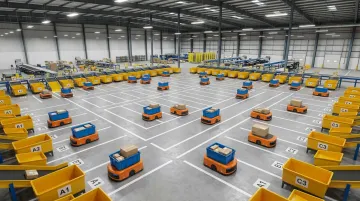
That scalability shows up in practice. Komar Distribution Services, a 3PL supporting more than 100 brands and 500 retailers, implemented tSort using 83 robots across a 7,300 sq ft footprint with 476 sortation destinations — achieving bottleneck removal without a facility overhaul.
Primary Advantages for Flexible Michigan Operations
- Reconfigurability — robots redeploy to new sort patterns without construction or downtime
- Phased capital investment — start with a core fleet and expand as volume justifies it
- Mixed SKU handling — well-suited for medical device, aerospace, and 3PL environments with high product variety
- Redundancy — one robot going offline doesn't stop the operation
Honest Limitations
- Software dependency adds complexity — calibration, updates, and WMS/ERP integration all require ongoing attention
- Throughput can lag high-speed conveyor lines at peak volume if the robot fleet is undersized
- Legacy WMS integration can be a friction point, especially in older Michigan manufacturing facilities
Ideal Use Cases in Michigan
Robotic sorters fit:
- 3PL operations managing multiple clients with different SKUs and fulfillment requirements
- Seasonal manufacturers (consumer goods, retail fulfillment) with large peak-to-off-peak volume swings
- Medical device and aerospace facilities requiring precise, auditable sortation with traceability
- Brownfield warehouses with irregular layouts that can't accommodate fixed conveyor runs
Interact Analysis forecasts the mobile robot market will grow at 19% annually from 2024 to 2030, reaching $14 billion — compared to 2.4% annual growth for fixed automation. For Michigan facilities planning capital investments with a 5–10 year horizon, that gap in growth rates matters.
Icon Material Handling designs automated solutions around each facility's specific bottlenecks, which makes robotic sorter integration a fit-first, product-second decision rather than a catalog selection.
Which System Is Right for Your Michigan Facility?
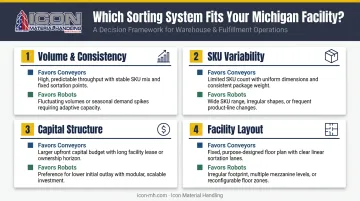
Four factors determine which technology delivers real value for your operation:
- Average daily sortation volume and consistency — high and stable volume favors conveyors; variable or seasonal volume favors robots
- Product and SKU variability — uniform products suit conveyors; mixed SKUs and changing client profiles suit robotic systems
- Capital structure preference — all-upfront vs. phased investment capability
- Facility layout constraints — existing footprint, lease term, retrofit feasibility, and ceiling height all affect which system physically fits
Situational Recommendations
Choose conveyor sortation if:
- Your Michigan facility processes consistently high daily volumes (thousands of uniform items per shift)
- Product mix is stable and unlikely to change significantly over the lease term
- You have a long-term lease with space for fixed infrastructure
- You need throughput certainty at peak — conveyors don't slow down when robots need charging
Choose robotic sortation if:
- Your operation handles variable SKUs, multiple client profiles, or pronounced seasonal peaks
- You need to reconfigure sort destinations regularly
- Phased capital deployment is preferable to a single large investment
- You're retrofitting a brownfield Michigan facility with layout constraints
Total Cost of Ownership: The Real Comparison
Published TCO benchmarks comparing conveyors against AMR sorters over 5–10 years don't exist in a reliable public form — any number you read is either vendor-provided or heavily site-dependent. What is documented:
- Conveyors have a lower cost-per-sort at sustained high volume over a long operational horizon
- Robotic systems often deliver a lower total outlay over shorter planning periods once labor savings from flexible deployment are included
- Geek+ claimed a 2–3 year ROI for their MiniSort system (2019 vendor data — treat as directional, not definitive)
- MHI identifies maintenance and spare parts availability as significant ongoing cost factors for conveyor systems
Neither system wins outright on cost alone. That's why many Michigan facilities are taking a hybrid path — conveyors handling primary bulk sortation flow, robots managing last-stage sorting, exceptions, or secondary sort destinations. Conveyors provide throughput at scale; robots fill the flexibility gaps.
Real-World Applications: Scenarios That Drive the Decision
Scenario 1: High-Volume Distribution, Conveyor Fit
A large parcel distribution hub processing consistent daily volume needs maximum throughput with minimal staffing. The trigger is typically a throughput bottleneck that manual sorting can't resolve without prohibitive headcount. Vanderlande's POSISORTER HC illustrates what mature conveyor technology delivers at this scale: 18,000 parcels/hour at 690 feet per minute, with 99.9% sorting accuracy and 99.5%+ system availability.
At consistent volume with a uniform product mix, fixed high-speed infrastructure drives lower per-unit costs than any flexible alternative — that's the core TCO argument for conveyors at this scale.
The risk worth noting: Vanderlande's own analysis warns that a single divert failure can hold up more than 10,000 parcels/hour. Availability engineering and preventive maintenance aren't optional at this scale.
Scenario 2: Flexible 3PL Operation, Robotic Fit
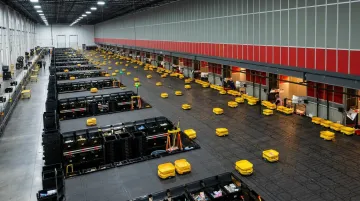
Komar Distribution Services — a 3PL supporting more than 100 brands across 500 retailers — faced the challenge most Michigan 3PLs recognize: variable fulfillment requirements across clients with different SKUs, packaging, and destination counts. A fixed conveyor system would have required constant reconfiguration. Instead, Komar deployed Tompkins Robotics tSort: 83 robots, 476 sort destinations, in 7,300 square feet. The result was bottleneck removal and reduced ergonomic strain without a facility overhaul.
What This Means for Michigan Operators
Your operational profile determines which system wins on total cost of ownership:
- Stable volume, uniform product mix: Conveyor sortation delivers better TCO over a 10-year horizon
- Variable clients, seasonal peaks, shifting SKUs: Robotic sortation adapts to client churn and seasonal surges without reconfiguration costs
Icon Material Handling works with Michigan facilities to assess which approach fits their actual operational profile, not their ideal one. Reach out for a facility-specific evaluation at Sales@icon-mh.com or +248-971-1455.
Conclusion
Neither system wins universally. Conveyor systems are purpose-built for scale and speed where operations are stable; robotic systems are built for adaptability and phased growth where change is constant.
Michigan's logistics landscape creates demand for both. The Detroit region alone hosts 10,635 logistics businesses and 183,340 industry workers, with warehousing job growth of 142% over five years.
A Grand Rapids retail fulfillment hub processing 15,000 uniform cartons per day has a different answer than a Detroit-area 3PL managing 50 brands through peak season.
The right system reduces labor dependency, improves order fulfillment speed, and provides scalable infrastructure for future growth. The right starting point is an honest audit of four factors:
- Volume stability — predictable daily throughput vs. seasonal or SKU-driven swings
- SKU variety — uniform carton profiles vs. mixed-size, mixed-weight inventory
- Growth trajectory — fixed capacity needs vs. phased expansion plans
- Capital structure — upfront CapEx tolerance vs. preference for modular, incremental investment
From there, the technology choice tends to clarify itself.
Frequently Asked Questions
How much does an automated warehouse sortation system cost?
Installed costs vary widely based on system type, facility size, throughput requirements, and integration complexity. Conveyor-based systems require higher upfront capital for equipment, integration, and building modifications; robotic systems typically offer lower entry costs with phased scaling options. Request facility-specific quotes rather than relying on published ranges.
Can conveyor and robotic sorter systems be used together?
Yes, hybrid models are increasingly common. Conveyors handle high-speed bulk flow while robots manage flexible secondary or last-stage sorting — a practical combination for Michigan operations that need throughput certainty at peak volume and flexibility for variable SKUs or exception handling.
What is the typical ROI timeline for a conveyor sortation system?
No verified public benchmark exists for conveyor sortation ROI. High-volume, well-justified installations are commonly cited in the 3–7 year payback range, though lower-volume operations often struggle to justify the capital required.
Which system is better suited for small to mid-sized Michigan warehouses?
Smaller operations generally benefit from robotic systems: lower upfront cost, modular scalability, and room to adjust as the business grows. Mid-sized facilities with consistently high, uniform throughput may still justify conveyors, but the real decision driver is daily volume and product consistency, not facility size.
How long does installation take for each system?
Conveyor installations for larger facilities can take several months to over a year, depending on infrastructure complexity. Robotic systems can typically be deployed in weeks with far less facility disruption, since they don't require fixed pathways or significant building modifications.
What ongoing maintenance costs should Michigan operators expect?
Conveyors require mechanical servicing of belts, rollers, and diverters, and a single-point failure can halt the entire line. Robotic systems need software updates and battery management, but individual unit downtime doesn't stop the operation. Both demand planned maintenance; conveyors carry higher disruption risk when that's deferred.